
A quadratic in standard form, y = ax² + bx + c, hides the most useful thing about its graph: where the parabola turns around. Vertex form puts that point right in the equation. This calculator converts between the two forms, shows the completing-the-square steps with your own numbers, and lists every key feature of the parabola, from the vertex and intercepts to the focus and directrix, with a graph to check against.
What vertex form tells you
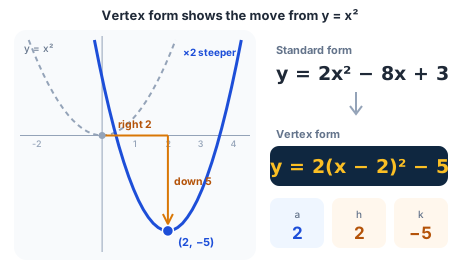
Each letter has a job you can read straight off the equation:
| Part | What it controls | Example: y = 2(x − 2)² − 5 |
|---|---|---|
| h | Left/right position of the vertex | vertex 2 units right |
| k | Up/down position of the vertex | vertex 5 units down |
| a > 0 | Opens upward, vertex is a minimum | minimum value −5 |
| a < 0 | Opens downward, vertex is a maximum | |
| |a| > 1 | Narrower than y = x² | twice as steep |
| |a| < 1 | Wider than y = x² |
The axis of symmetry is the vertical line x = h, so the two halves of the parabola mirror each other across it. The vertex and axis of symmetry lesson covers that relationship in more depth.
How to convert to vertex form (step by step)
The calculator opens on y = 2x² − 8x + 3. Converting it means completing the square, which is just a tidy way to rewrite the x² and x terms as one squared bracket.
Step One: Factor a out of the x terms
Only the x² and x terms go inside the bracket. The constant stays outside.
y = 2x² − 8x + 3
y = 2(x² − 4x) + 3
Step Two: Add and subtract the square of half the x coefficient
Half of −4 is −2, and (−2)² = 4. Adding 4 and subtracting 4 inside the bracket changes nothing, but it creates a perfect square.
y = 2(x² − 4x + 4 − 4) + 3
Step Three: Move the extra term out, multiplied by a
The −4 is inside a bracket that’s multiplied by 2, so it leaves as −8. Forgetting this multiplication is the most common mistake in the whole process.
y = 2(x² − 4x + 4) − 8 + 3
Step Four: Write the square and combine the constants
x² − 4x + 4 is (x − 2)², and −8 + 3 = −5.
y = 2(x − 2)² − 5
vertex (h, k) = (2, −5)
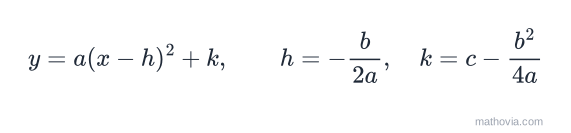
You can check it with the shortcut formulas, which come from doing these same steps with letters instead of numbers:
h = −b ÷ 2a = 8 ÷ 4 = 2
k = c − b² ÷ 4a = 3 − 64 ÷ 8 = 3 − 8 = −5
For a deeper walk through the method, including when a is a fraction, see the completing the square lesson.
Converting vertex form back to standard form
Going the other way is just expanding. Square the bracket, multiply through by a, then add k.
y = 2(x − 2)² − 5
  = 2(x² − 4x + 4) − 5
  = 2x² − 8x + 8 − 5
  = 2x² − 8x + 3
In general, b = −2ah and c = ah² + k. The second tab in the calculator does this conversion and shows each step.
Finding the equation from the vertex and a point
A common homework question gives you the vertex and one other point and asks for the equation. The vertex fixes h and k, so the only unknown left is a.
vertex (2, −5), point (0, 3)
y = a(x − 2)² − 5
3 = a(0 − 2)² − 5
8 = 4a
a = 2   →   y = 2(x − 2)² − 5
The point can’t sit directly above or below the vertex (same x), and it can’t be level with it (same y), because neither tells you anything about a.
Intercepts, focus and directrix
Vertex form also makes the x-intercepts easy to find without the quadratic formula. Set y = 0 and undo the operations in reverse:
0 = 2(x − 2)² − 5
(x − 2)² = 5/2
x = 2 ± √2.5 ≈ 0.4189 and 3.5811
If k and a have the same sign, the square would have to equal a negative number, so there are no x-intercepts. The discriminant b² − 4ac tells you the same thing from standard form: here it’s 64 − 24 = 40, which is positive, so the graph crosses the axis twice.
The focus and directrix come from the focal distance p = 1 ÷ 4a. For a = 2, p = 1/8:
focus      (h, k + p) = (2, −5 + 1/8) = (2, −39/8) = (2, −4.875)
directrix  y = k − p  = −5 − 1/8 = −41/8 = −5.125
Every point on the parabola is exactly as far from the focus as from the directrix. That property is why satellite dishes and car headlights use parabolic reflectors: signals arriving parallel to the axis all bounce to the focus. The parabolas lesson has more on these features.
Vertex form in a real problem: maximum height
Vertex form earns its keep when a question asks for a maximum or minimum, because the answer is sitting right in the equation. A ball thrown upward from 5 ft at 64 ft/s follows h(t) = −16t² + 64t + 5, where t is in seconds and h in feet. How high does it go, and when?
a = −16, b = 64, c = 5
h = −b ÷ 2a = −64 ÷ (−32) = 2
k = c − b² ÷ 4a = 5 − 4096 ÷ (−64) = 5 + 64 = 69
h(t) = −16(t − 2)² + 69
The ball peaks at 69 ft, 2 seconds after it’s thrown. Because a is negative, the vertex is a maximum. The same idea finds the price that maximizes revenue or the dimensions that give the largest area. Write the quadratic, convert it to vertex form, and read off (h, k). Enter a = −16, b = 64, c = 5 in the calculator to check it. The quadratic applications lesson has more problems of this type.
Common mistakes with vertex form
- Getting the sign of h wrong. y = (x + 3)² has its vertex at x = −3, not 3.
- Not multiplying by a when moving the constant out. In step three above, the −4 leaves the bracket as −8 because of the 2 in front.
- Completing the square before factoring out a. Half of b only works when the x² coefficient inside the bracket is 1.
- Forgetting a when finding intercepts. Divide by a before taking the square root.
- Reading k as the y-intercept. k is the height of the vertex. The y-intercept is c, the value of y when x = 0, which here is 3.