
A fraction like 18/24 and its simplified form 3/4 are the same value written two ways — 3/4 is just easier to read, compare, and use as a final answer. Simplifying (or “reducing”) means dividing the numerator and denominator by the largest number that goes into both, until nothing bigger than 1 divides them both.
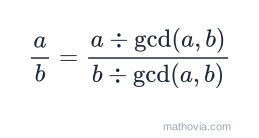
The simplifying formula
Worked example
The calculator’s default is 18/24.
Check:
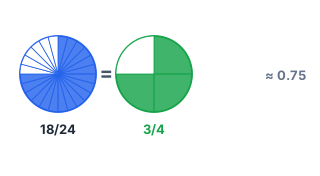
What your results mean
The simplified numerator and denominator are your fraction in lowest terms — the version you’d write as a final answer. The GCD shows exactly what number both the original numerator and denominator were divided by; a GCD of 1 means the fraction you entered was already fully simplified.
The decimal confirms the value didn’t change — it will always match the decimal value of your original, unsimplified fraction.
Why finding the GCD directly beats guessing
You could simplify in stages — dividing 18/24 by 2 to get 9/12, then by 3 to get 3/4 — and you’d land on the same answer. But finding the GCD up front (using repeated division, known as the Euclidean algorithm) gets there in one step instead of several, which matters more as numbers get larger. For 84/126, guessing common factors one at a time takes a while; the GCD is 42, and dividing once gets straight to 2/3.
Common simplified fractions
| Fraction | GCD | Simplified |
|---|---|---|
| 4/8 | 4 | 1/2 |
| 6/9 | 3 | 2/3 |
| 10/15 | 5 | 2/3 |
| 12/18 | 6 | 2/3 |
| 15/25 | 5 | 3/5 |
| 21/28 | 7 | 3/4 |
Notice several different starting fractions in that table simplify to the same 2/3 — they’re all equivalent fractions of each other, just scaled differently.
To go the other direction and scale a simplified fraction back up, try the equivalent fractions calculator. To compare two fractions directly without simplifying either one first, use the comparing fractions calculator.
Finding the GCD with the Euclidean algorithm
For large numbers, listing factors is slow. The Euclidean algorithm finds the GCD by repeated division, keeping only the remainders. For 84 and 126:
The last nonzero remainder, 42, is the GCD. So
Using prime factors instead
Break both numbers into primes and cancel what they share. For
The shared primes
Quick divisibility checks
These help spot a common factor at a glance:
- 2: the last digit is even.
- 3: the digits add up to a multiple of 3 (for 84,
). - 5: the number ends in 0 or 5.
- 9: the digits add up to a multiple of 9.
- 10: the number ends in 0, so you can cross a zero off top and bottom.
Common mistakes
- Stopping too early.
is a step, not an answer. Check that the new numerator and denominator share no factor. - Cancelling digits. In
, crossing out the 6s happens to give , but it’s a coincidence. would give the same way, and that’s wrong. - Dividing only one part. Both numerator and denominator must be divided by the same number.
- Cancelling across a sum.
does not simplify to . Only common factors cancel, never terms.
Simplifying algebraic fractions
The rule is the same with variables: cancel common factors, never terms. Factor the numbers and powers first:
When the top or bottom is a sum, factor it before cancelling:
Simplify, then convert
For an improper fraction, simplify first and then turn it into a mixed number.
Try these
| Fraction | Simplest form |
|---|---|
| 45/60 | 3/4 |
| 56/98 | 4/7 |
| 120/144 | 5/6 |
| 91/119 | 13/17 |
| 75/125 | 3/5 |
91/119 is the tricky one: both share a factor of 7, which is easy to miss.