
A percent is a fraction with the denominator fixed at 100. “1/8” and “12.5%” describe the same portion — one as a piece out of 8, the other as a piece out of 100. This calculator converts any fraction, proper or improper, straight to its percent form.
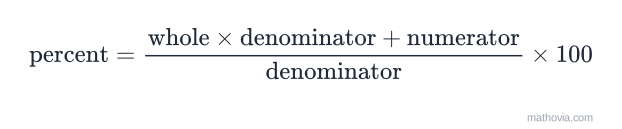
The fraction to percent formula
It’s the fraction-to-decimal division followed by a ×100, because “percent” means “per hundred.”
Worked example
The calculator’s defaults are whole 0, numerator 1, denominator 8.
For an improper fraction like 5/4:
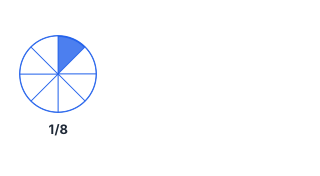
What your results mean
The percent is your fraction rescaled to be “out of 100” — the form most people picture instantly, whether it’s a discount, a test score, or a probability. The decimal shown alongside it is the same value before that final ×100 step, useful if you need to plug the number into another formula that expects a decimal rather than a percent.
Common fractions as percents
| Fraction | Percent |
|---|---|
| 1/2 | 50% |
| 1/4 | 25% |
| 1/8 | 12.5% |
| 1/5 | 20% |
| 1/3 | 33.33% |
| 3/4 | 75% |
| 5/4 | 125% |
The last row is a reminder that percents aren’t capped at 100% — any fraction greater than 1 converts to a percent above 100%.
Do I need to reduce the fraction first?
No.
Common mistakes
- Stopping at the decimal.
is the decimal; the percent needs the final , giving 12.5%, not 0.125%. - Assuming the answer can’t exceed 100. An improper fraction like
is 175% — perfectly valid. - Rounding a repeating result too early.
is 33.333…%; carry the extra digits if the percent feeds into another calculation. - Reading a mixed number wrong.
is , which is 250%, not 21%.
Where this comes up
Grades, discounts, interest rates, survey results, and probabilities are all commonly expressed as percents even when the underlying math starts as a fraction — “3 out of 4 correct” is naturally 3/4, but it’s reported as 75%. If you need the reverse conversion, start from the decimal to fraction calculator after dividing your percent by 100. For the plain decimal form without the percent scaling, see the fraction to decimal calculator.
Converting in your head
If the denominator divides into 100, scale the fraction straight to hundredths and the numerator is the percent:
For eighths, remember
Going back from a percent to a fraction
Write the percent over 100 and simplify.
A worked test-score example
A student gets 23 out of 30 questions right. As a percent:
If the pass mark is 75%, they’ve passed. To find the minimum score needed instead, work backwards:
Scores and results as percents
“Out of” questions are fractions in disguise. A student who scores 18 out of 24 has
Percent change as a fraction
Percent change is the change over the starting value. A price that rises from 40 to 50 dollars changes by 10, so:
The denominator is always the original amount. Going back down from 50 to 40 is a change of
Try these
| Fraction | Percent |
|---|---|
| 7/20 | 35% |
| 3/16 | 18.75% |
| 5/12 | about 41.67% |
| 9/8 | 112.5% |
| 2/9 | about 22.22% |
For more, the percentage practice problems generate fresh questions each time.