
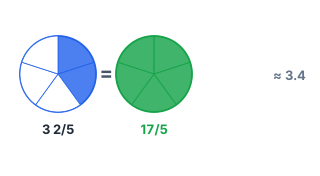
An improper fraction packs a whole number and a fraction into a single number over a single denominator — 3 2/5 becomes 17/5. This form is awkward to read but far easier to use in further calculations, which is why it’s the standard first step before adding, subtracting, multiplying, or dividing mixed numbers.
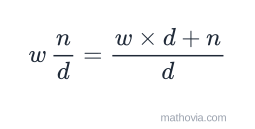
The mixed-to-improper formula
Multiply the whole number by the denominator, add the numerator, and keep the denominator.
Worked example
The calculator’s default is 3 2/5.
Check with decimals:
What your results mean
The numerator and denominator together form the improper fraction equivalent to your mixed number — a single fraction with no separate whole part, ready to plug into an addition, subtraction, multiplication, or division of fractions. The decimal value is there so you can confirm the conversion: it should always match your original mixed number’s value exactly, since converting to an improper fraction never changes the actual quantity.
Common mixed numbers and their improper fractions
| Mixed number | Improper fraction |
|---|---|
| 1 1/2 | 3/2 |
| 2 3/4 | 11/4 |
| 4 1/3 | 13/3 |
| 3 2/5 | 17/5 |
| 5 5/6 | 35/6 |
Every improper fraction in that table has a numerator larger than its denominator, which is exactly what makes it “improper” — it represents a value of 1 or more.
Where this comes up
Converting to an improper fraction is the required first step before multiplying or dividing mixed numbers, since those operations don’t work correctly on the whole-number and fraction parts separately. It’s also useful whenever a formula, spreadsheet, or program expects a single fraction rather than a mixed number. For the reverse conversion — turning an improper fraction back into a mixed number — use the improper fraction to mixed number calculator. To add two mixed numbers directly without converting by hand, try the mixed number calculator.
Why the formula works
A mixed number is a sum:
That’s all “multiply by the denominator and add the numerator” is doing.
Why you convert before multiplying
It’s tempting to multiply the whole numbers and the fractions separately. It gives the wrong answer. Take
The separate method misses the cross terms, the whole of one number times the fraction of the other. Converting first avoids that.
Division works the same way:
Common mistakes
- Multiplying the wrong pair. For
, it’s , not . - Changing the denominator. The denominator stays 5; only the numerator grows.
- Mishandling a negative.
means , so it becomes , not . Convert the positive version, then attach the sign. - Converting only one number. When multiplying or dividing two mixed numbers, convert both before you start.
A quick check that catches most slips
The new numerator must sit between
Scaling a recipe
Improper fractions make scaling easy. A recipe needs
Multiplying the mixed number directly tempts people to triple only the 2 and get
Try these
| Mixed number | Improper fraction |
|---|---|
| 2 3/8 | 19/8 |
| 5 1/6 | 31/6 |
| 7 2/3 | 23/3 |
| 10 4/5 | 54/5 |
| 1 11/12 | 23/12 |
Cover the right-hand column, work each one out, then check. For unlimited mixed practice, the fraction practice problems generate new sets at three difficulty levels.