Mathovia

Math / Fractions & Decimals

Comparing Fractions Calculator

Enter two fractions to see which one is bigger, smaller, or equivalent — no need to find a common denominator first.

vs
Comparison
The first fraction is larger
First fraction as a decimal
0.7500
Second fraction as a decimal
0.6250
Cross-multiplication difference
4
3/4vs5/8
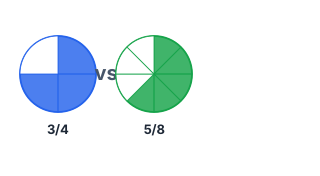
Both bars are the same length, so the one with more shading is the larger fraction — no common denominator needed to see it.

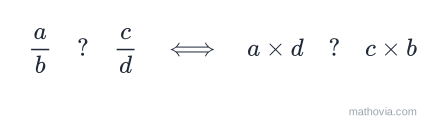
Cross-multiplying both fractions (a/b vs c/d becomes a×d vs c×b) avoids finding a common denominator. The sign of the difference tells you which fraction is larger, without ever reducing anything.

Written by
MPhil in Mathematics, Founder of Mathovia
Updated

Mathematics verification: Mathematical formulas, calculations, worked examples and solutions are reviewed for accuracy before publication. How we check our work

Two fractions with different denominators don’t compare at a glance. Is 3/4 bigger than 5/8? The numerators (3 and 5) suggest the second one might be larger, but the denominators are different sizes of “piece,” so you can’t compare numerators alone. This calculator settles it instantly and shows the reasoning.
Comparing Fractions Calculator formula
The Comparing Fractions formula

The cross-multiplication rule

Compare against . If the left product is larger, is the larger fraction; if smaller, it’s the smaller one; if equal, the fractions are equivalent. This works because it’s the same as putting both fractions over the common denominator and comparing numerators — just without dividing.

Worked example

The calculator’s defaults are 3/4 and 5/8.

24 > 20, so 3/4 is larger than 5/8. The decimals confirm it: and .
Comparing Fractions Calculator worked example diagram
A visual read of the worked example above — the same numbers the calculator returns for its default inputs.

What your results mean

The Comparison result tells you directly which fraction is larger, smaller, or whether they’re equal. The cross-multiplication difference is the number behind that call — positive means the first fraction wins, negative means the second one does, and zero means the fractions are equivalent (like 2/4 and 1/2, which look different but represent the same amount).

The two decimal values are there so you can double-check the comparison by eye, or use them directly if you need the actual size of the gap between the fractions rather than just which one is bigger.

When cross-multiplication is worth it

For a single side-by-side comparison, cross-multiplying beats finding a least common denominator — it’s one multiplication per side instead of first computing an LCM and then rewriting both fractions. If you actually need to add or subtract the fractions afterward, though, you’ll want the common denominator anyway, so it’s worth finding at that point.

Common mistakes to avoid

  • Comparing numerators alone. 5 is bigger than 3, but 5/8 is not bigger than 3/4 — the denominators change what each numerator is worth.
  • Cross-multiplying with a negative denominator. This method assumes both denominators are positive; if either fraction has a negative denominator, rewrite it with the negative sign on the numerator first.
  • Forgetting equivalent fractions can look different. 4/6 and 2/3 compare as equal even though neither number matches — check with the equivalent fractions calculator if the result surprises you.

For the actual sum or difference between two fractions, use the adding fractions calculator or convert either fraction with the fraction to decimal calculator.

Three shortcuts that skip the arithmetic

Compare with one half. is less than a half (half of 7 is 3.5) and is more, so is bigger. Any time one fraction sits below and the other above, you’re done.

Same numerator. With equal numerators, the smaller denominator wins, because the pieces are bigger. .

Distance from 1. is short of a whole; is only short. The one closer to 1 is bigger, so .

Putting several fractions in order

To order , and , rewrite them all over the LCD of 3, 8 and 12, which is 24:

Now compare numerators: . For more than two fractions, a common denominator is faster than cross-multiplying every pair.

Comparing mixed numbers

Compare the whole numbers first. beats because 3 is more than 2, whatever the fractions say. Only when the whole numbers match do you need to compare the fraction parts.

Comparing negative fractions

With negatives the order flips. Compare the sizes first, then reverse: , so . On a number line, sits closer to zero, which makes it the larger number.

Comparing a fraction with a decimal

Convert the fraction to a decimal and compare digit by digit. Is bigger than 0.6? , and 0.625 > 0.600, so yes. Writing both to the same number of decimal places makes the comparison easy to see.

Try these

PairLarger
5/9 or 4/74/7 (35 < 36)
7/10 or 2/37/10 (21 > 20)
11/15 or 3/43/4 (44 < 45)
6/14 or 3/7Equal
−2/3 or −3/4−2/3

The numbers in brackets are the cross-products, first fraction’s first.

About the formula: Cross-multiplying both fractions (a/b vs c/d becomes a×d vs c×b) avoids finding a common denominator. The sign of the difference tells you which fraction is larger, without ever reducing anything.

Frequently Asked Questions

Is 3/4 bigger than 5/8?+

Yes. Cross-multiply: 3 × 8 = 24 versus 5 × 4 = 20. 24 is larger, so 3/4 (0.75) beats 5/8 (0.625).

Why does cross-multiplication work?+

Multiplying both sides of a/b vs c/d by b×d — positive when both denominators are positive — turns it into a×d vs c×b, a plain whole-number comparison with no common denominator needed.

How do I compare fractions with negative numerators?+

Put the minus sign on the numerator (−3 for −3/4). Cross-multiplication keeps the sign relationship correct as long as both denominators are positive.

Is cross-multiplying faster than a common denominator?+

For two fractions, yes — one multiplication per side versus finding the LCM and rewriting both. For three or more, convert everything to decimals or a shared denominator instead.

How do I compare more than two fractions?+

Convert them all to decimals and sort, or put them over one common denominator and compare numerators. Cross-multiplication only handles a pair at a time.

What if the two fractions are equal?+

The cross-products match and the difference is zero. 2/4 versus 1/2 gives 2×2 = 4 and 1×4 = 4 — equal, even though the numbers look different.

Related calculators