Mathovia

Math / Fractions & Decimals

Improper Fraction to Mixed Number Calculator

Enter an improper fraction (numerator larger than the denominator) to convert it into a whole number plus a proper fraction.

Whole number
3
Remainder — numerator
2
Remainder — denominator
5
Decimal
3.4000
3 2/5
The whole-number part is written in the label; the bar shows only the fraction left over once the whole parts are taken out.

Dividing the numerator by the denominator gives a whole-number quotient and a leftover remainder. The whole number becomes the mixed number's whole part, and the remainder over the original denominator becomes its fraction part.

Written by
MPhil in Mathematics, Founder of Mathovia
Updated

Mathematics verification: Mathematical formulas, calculations, worked examples and solutions are reviewed for accuracy before publication. How we check our work

An improper fraction like 17/5 is really saying “more than three whole units,” but it’s not written that way — it’s written as one big fraction. Converting it to a mixed number (a whole number plus a proper fraction) makes that quantity easier to picture and easier to use in everyday measurements.
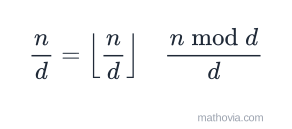
Improper Fraction to Mixed Number Calculator formula
The Improper Fraction to Mixed Number formula

The improper-to-mixed formula

The whole part is divided by , rounded down. The remainder becomes the new numerator, over the same denominator .

Worked example

The calculator’s default is 17/5.

Check with decimals: , and .
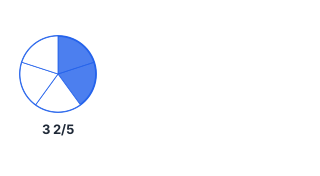
Improper Fraction to Mixed Number Calculator worked example diagram
A visual read of the worked example above — the same numbers the calculator returns for its default inputs.

What your results mean

The whole number is the number of full units contained in the improper fraction. The remainder numerator and remainder denominator together form the leftover fraction part, which is always less than 1 (a proper fraction) — that’s what makes a mixed number easier to read at a glance than the original improper fraction.

The decimal value is there to double-check your answer: adding the whole number to the remainder fraction’s decimal value should always match dividing the original numerator by the original denominator directly.

Common improper fractions and their mixed numbers

Improper fractionMixed number
7/41 and 3/4
9/24 and 1/2
11/33 and 2/3
22/82 and 6/8 (simplifies to 2 and 3/4)
25/55 (no remainder)

The last row shows what happens when the numerator divides evenly — the “mixed number” is just a whole number with no fraction part left over.

To go the other direction, converting a mixed number back into a single improper fraction, use the mixed number to improper fraction calculator. If your remainder fraction needs reducing, run it through the fraction simplifier.

Doing it by hand: a second example

Take . Ask how many whole 6s fit into 47: , and is too big, so the whole number is 7. The leftover is , which stays over the original denominator:

To check, convert back: . If you get the original numerator, the answer is right.

Where mixed numbers are the better form

Mixed numbers are easier to picture, which is why they’re used for measurements and final answers. A board that’s inches long is hard to find on a tape measure; inches is easy. Recipes work the same way: cups, not .

For working, improper fractions usually win. Multiplying, dividing and most algebra are simpler with a single fraction, so a common habit is to work in improper fractions and convert to a mixed number only at the end.

Common mistakes

  • Putting the remainder over the wrong number. is , not . The remainder sits over the original denominator, not over the whole number.
  • Writing the quotient as the numerator. The quotient is the whole number. The remainder becomes the new numerator.
  • Leaving the fraction part unsimplified. gives , which should be finished as .
  • Reading a mixed number as multiplication. means , not .

Using a basic calculator

Without a fraction key, divide and use the whole-number part. For , the display shows 36.4166…, so the whole number is 36. Find the remainder by multiplying back:

Don’t try to turn the decimal 0.4166… into the fraction directly; multiplying back is exact.

The same idea in algebra

Dividing polynomials works the same way. An “improper” rational expression, where the top has a degree at least as high as the bottom, can be split into a whole part plus a remainder fraction:

Just as , the quotient is the “whole” part and the remainder stays over the original denominator. The rational expressions lesson picks this up.

Try these

Improper fractionMixed number
29/47 1/4
50/77 1/7
83/99 2/9
100/128 1/3 (from 8 4/12)
437/1236 5/12
About the formula: Dividing the numerator by the denominator gives a whole-number quotient and a leftover remainder. The whole number becomes the mixed number's whole part, and the remainder over the original denominator becomes its fraction part.

Frequently Asked Questions

What is 17/5 as a mixed number?+

3 2/5. Divide 17 by 5 to get 3 with a remainder of 2, and the remainder sits over the original 5.

What makes a fraction 'improper'?+

Its numerator is greater than or equal to its denominator, so it's worth 1 or more. 17/5, 9/9, and 12/7 are all improper.

Why does the remainder keep the original denominator?+

The leftover is still measured in the same size pieces. 17/5 has three whole groups of 5 (that's 15), leaving 2 pieces out of the next group of 5 — so 2/5.

Is the mixed number automatically simplified?+

No. If the leftover fraction shares a factor with the denominator, reduce it. 22/8 converts to 2 6/8, which simplifies to 2 3/4.

What if the numerator divides evenly?+

There's no fraction part — 25/5 is just 5. The calculator shows a remainder numerator of 0.

How do I convert a negative improper fraction?+

Convert the size normally and put the sign on the whole quantity. −17/5 is −3 2/5, meaning −(3 2/5), not −3 + 2/5.

Related calculators