
Equivalent fractions represent the same value written with different numbers — 1/2, 2/4, and 5/10 are all exactly one-half, just split into a different number of equal pieces. This chart shows the first several equivalents for the fractions people look up most.
Halves, thirds, and quarters
| Fraction | ×2 | ×3 | ×4 | ×5 |
|---|---|---|---|---|
| 1/2 | 2/4 | 3/6 | 4/8 | 5/10 |
| 1/3 | 2/6 | 3/9 | 4/12 | 5/15 |
| 2/3 | 4/6 | 6/9 | 8/12 | 10/15 |
| 1/4 | 2/8 | 3/12 | 4/16 | 5/20 |
| 3/4 | 6/8 | 9/12 | 12/16 | 15/20 |
Fifths and eighths
| Fraction | ×2 | ×3 | ×4 | ×5 |
|---|---|---|---|---|
| 1/5 | 2/10 | 3/15 | 4/20 | 5/25 |
| 2/5 | 4/10 | 6/15 | 8/20 | 10/25 |
| 1/8 | 2/16 | 3/24 | 4/32 | 5/40 |
| 3/8 | 6/16 | 9/24 | 12/32 | 15/40 |
Every fraction in a row shares the same decimal value — read across 1/4, 2/8, 3/12, 4/16, and 5/20, and each one equals exactly 0.25.
How to generate an equivalent fraction
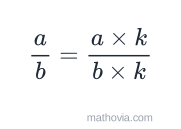
Multiply the numerator and denominator by the same nonzero number. Because that’s the same as multiplying by n/n — which always equals 1 — the fraction’s value never changes, only how it’s written.
1/4 scaled by 3:
numerator:   1 × 3 = 3
denominator: 4 × 3 = 12
1/4 = 3/12
Finding an equivalent fraction with a specific denominator
Divide your target denominator by the current one to find the scale factor, then apply it to the numerator. To rewrite 2/3 with a denominator of 15:
scale factor = 15 ÷ 3 = 5
new numerator = 2 × 5 = 10
2/3 = 10/15
This is exactly the technique used to give two fractions a common denominator before adding or subtracting them. If the target denominator isn’t a whole-number multiple of the original — say you want 1/3 over a denominator of 10 — then no exact equivalent exists with that denominator, and you’d work with the least common denominator of both fractions instead.
Checking whether two fractions are equal
Cross-multiply: multiply the numerator of each by the denominator of the other. If the two products match, the fractions are equivalent. For 3/4 and 9/12: 3 × 12 = 36 and 4 × 9 = 36, so they’re equal. For 2/3 and 5/8: 2 × 8 = 16 but 3 × 5 = 15, so they’re not.
Try it with your own numbers
For any starting fraction and scale factor, use the equivalent fractions calculator to generate the result instantly. To go the other direction — reducing a fraction down to its simplest equivalent — use the fraction simplifier. And if you need the smallest denominator two specific fractions can share, see the least common denominator calculator.