
Mixed numbers are the form people actually use in daily life — “2 and 1/3 cups,” “1 and 3/4 miles” — but adding two of them means combining both the whole-number parts and the fraction parts correctly, without losing track of a carry when the fractions overlap.

How mixed-number addition works
Convert each mixed number to an improper fraction, add over a common denominator, then convert back:
Worked example
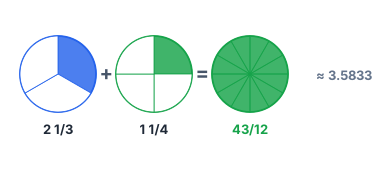
The calculator’s defaults are 2 1/3 + 1 1/4.
Convert both:
Common denominator (LCD of 3 and 4 is 12):
Back to a mixed number:
What your results mean
The fraction form (43/12) is the exact, unrounded answer as an improper fraction — useful if this result feeds into another calculation. When the numerator is larger than the denominator, the calculator also shows the equivalent mixed number underneath (3 and 7/12), which is usually the form you actually want to read or write down. The decimal form is there for a quick sanity check or for plugging into a calculator that doesn’t accept fractions.
Watch for carrying
If the fraction parts of two mixed numbers add up to more than 1, that extra whole unit needs to move into the whole-number total. For example, 1 3/4 + 2 1/2 has fraction parts 3/4 + 1/2 = 5/4, which is more than a whole — so the answer isn’t “3 and 5/4,” it’s 4 and 1/4 (the extra whole unit from 5/4 folds into the 3 to make 4). Converting to improper fractions first, as this calculator does, avoids that mistake entirely by removing the need to carry by hand.
Where this comes up
Recipes scaled by mixed amounts, board lengths in feet and inches, and combined race or workout distances are all everyday mixed-number addition. For subtraction, use the subtracting fractions calculator, which accepts mixed numbers the same way. If you’d rather work with the improper fraction directly, convert first with the mixed number to improper fraction calculator.
Adding without converting: the column method
For small numbers many people add the parts separately, and that’s fine for addition as long as you handle the carry. Using the defaults:
- Whole parts:
. - Fraction parts:
. - The fraction part is less than 1, so there’s no carry:
.
Same answer as the calculator, with smaller numbers along the way. The improper-fraction route is safer for subtraction and the only correct route for multiplication and division.
Subtracting mixed numbers and borrowing
Subtraction is where the column method trips people up. Try
Converting both to improper fractions avoids the borrow entirely:
A real example: joining two boards
A shelf needs a board of
The fractions added to more than a whole, so one whole carried over. That carry is the step most often missed when adding by hand.
Common mistakes
- Adding denominators.
is not . Find a common denominator first. - Forgetting the carry.
is not a finished answer; rewrite it as . - Dropping the whole part.
converts to . Writing just loses the 2. - Not simplifying the fraction part.
should be written .
Estimate before you calculate
Round each mixed number to a whole number and add.
When the fractions add to more than one
The defaults don’t carry, but many sums do. For
Try these
| Sum | Answer |
|---|---|
| 1 2/3 + 2 3/4 | 4 5/12 |
| 3 1/2 + 4 5/6 | 8 1/3 |
| 2 3/8 + 1 1/2 | 3 7/8 |
| 5 4/5 + 2 7/10 | 8 1/2 |
| 6 1/4 + 3/4 | 7 |