
Every terminating decimal is a fraction in disguise. 0.5 is 1/2, 0.75 is 3/4, 0.625 is 5/8. The work is knowing how many zeros go in the denominator and how far the fraction reduces — this calculator does both and shows the greatest common divisor it used.
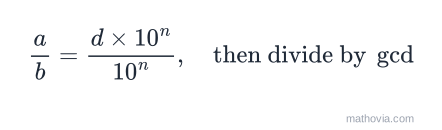
The decimal to fraction method
Write the decimal
Worked example
The calculator’s defaults are 0.625, converted at 3 digits.
Check:

What your results mean
The numerator and denominator are your answer in lowest terms — this is the fraction you’d write on paper. The GCD used to simplify shows exactly what number both the raw numerator (625) and raw denominator (1000) were divided by to get there; if the GCD is 1, the fraction was already in lowest terms before simplifying.
The decimal used field shows the decimal value after rounding to your chosen digit count. If it doesn’t match what you typed, you rounded at fewer digits than your original number had — try a higher digit setting for more precision.
Common decimals and their fractions
| Decimal | Fraction | GCD used |
|---|---|---|
| 0.5 | 1/2 | 5 |
| 0.25 | 1/4 | 25 |
| 0.75 | 3/4 | 25 |
| 0.125 | 1/8 | 125 |
| 0.375 | 3/8 | 125 |
| 0.2 | 1/5 | 2 |
Notice the GCD is what does the real work — a decimal like 0.5 (500/1000) needs a GCD of 500 to collapse all the way down to 1/2, while 0.375 only needs 125.
A note on precision
Choosing more decimal digits than your number actually has doesn’t hurt — trailing zeros just get absorbed into the GCD. But choosing fewer digits than you meant will round your input, which matters for anything beyond simple fractions. If you’re working from a measurement, it can help to check the result against the fraction to decimal calculator run in reverse, or compare it to the equivalent fractions calculator to see other fractions that represent the same value.
Decimals with a whole number part
Handle the whole number separately and convert only the decimal part. For 2.75, the decimal part is 0.75:
Whether you write
Converting a repeating decimal
The digit-count method only works for decimals that end. For one that repeats forever, use algebra. Let
The pattern is worth remembering: a single repeating digit goes over 9 (
Reading the place value aloud
A shortcut that needs no formula: say the decimal using its place value name, and the fraction writes itself. 0.35 is “thirty-five hundredths”, so it’s
Common mistakes
- Wrong power of 10. 0.06 has two decimal places, so it’s
, not . Count digits after the point, including zeros. - Not simplifying.
is correct but unfinished. Divide by the GCD to reach . - Treating a rounded decimal as exact. 0.33 is
, not . If the decimal really repeats, use the repeating method above. - Losing the whole number. 3.2 is
, not .
Decimal inches to a ruler fraction
Machinists and CAD drawings give decimals; tape measures show sixteenths. 0.4375 inch is
Decimals that repeat after a delay
In 0.1666…, only the 6 repeats. Multiply to line up the repeating parts, then subtract:
Try these
| Decimal | Fraction |
|---|---|
| 0.45 | 9/20 |
| 0.125 | 1/8 |
| 1.6 | 1 3/5 |
| 0.0625 | 1/16 |
| 0.36 | 9/25 |