
Equivalent fractions look different but mean the same amount — 1/2, 2/4, and 50/100 are all exactly half. This calculator makes one equivalent fraction at a time by scaling the numerator and denominator by the same factor, the exact move you use to put two fractions over a common denominator before adding or subtracting.
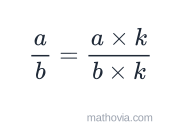
The equivalent fraction formula
Worked example
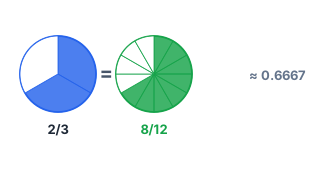
The calculator’s defaults are 2/3 scaled by 4.
Both equal
What your results mean
The equivalent numerator and equivalent denominator together form a new fraction with a larger numerator and denominator than you started with, but the exact same value. The value (unchanged by scaling) field shows that decimal explicitly, so you can confirm the original and scaled fractions really do match.
This is the same operation used behind the scenes whenever two fractions need a common denominator before they can be added or subtracted — each fraction gets scaled up to a shared denominator without changing what it represents.
A short table of equivalents
| Starting fraction | ×2 | ×3 | ×5 |
|---|---|---|---|
| 1/2 | 2/4 | 3/6 | 5/10 |
| 2/3 | 4/6 | 6/9 | 10/15 |
| 3/4 | 6/8 | 9/12 | 15/20 |
| 1/5 | 2/10 | 3/15 | 5/25 |
Every fraction in a row has the same decimal value as the one to its left — only the pieces got smaller and more numerous.
Where this comes up
Finding equivalent fractions is the first real step in adding or subtracting fractions with different denominators, comparing fractions at a glance, and simplifying a recipe or measurement into more convenient units. If you need to go the other way — reducing a fraction down to its simplest equivalent — use the fraction simplifier instead. To rewrite two fractions over their smallest shared denominator specifically, see the least common denominator calculator.
Finding the missing number
Many worksheet questions give an equivalent fraction with one gap, like
If the known side gets smaller, divide instead:
Checking whether two fractions are equivalent
Cross-multiply. Two fractions
and : and . Equivalent. and : but . Not equivalent.
Another reliable check is to simplify both. Equivalent fractions always reduce to the same lowest-terms fraction.
Common mistakes
- Adding instead of multiplying. Adding 2 to top and bottom of
gives , which is a different amount. Only multiplying or dividing both parts by the same number keeps the value. - Scaling only one part.
is not equivalent to ; it’s four times bigger. - Using a factor that doesn’t divide evenly. When scaling down, the factor must go into both numbers.
can be divided by 3, but not by 2. - Assuming bigger numbers mean a bigger fraction.
looks larger than , but it’s the same amount cut into smaller pieces.
Building a list of equivalents
Multiply the numerator and denominator by 2, 3, 4 and so on. For
The numerators count up in 3s and the denominators in 4s. Any fraction whose numerator and denominator are in that 3-to-4 pattern belongs to the same family.
Equivalent fractions in algebra
The same rule works with letters. Multiplying top and bottom by the same nonzero expression doesn’t change the value:
That’s exactly how rational expressions get a common denominator before they’re added. The rational expressions lesson uses this step throughout.
Try these
| Question | Answer |
|---|---|
| 3/5 = ?/35 | 21 |
| 4/9 = ?/54 | 24 |
| 12/18 = 2/? | 3 |
| 5/8 = 40/? | 64 |
| 7/12 = ?/60 | 35 |