
A fraction and a ratio are two notations for the same relationship between two numbers. The fraction 8/12 and the ratio 8:12 both compare 8 of one thing to 12 of another, and both reduce the same way — by dividing out the greatest common divisor.
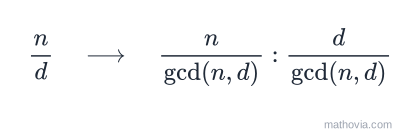
The fraction to ratio formula
Divide both the numerator and denominator by their GCD; the two results, written with a colon, are the simplified ratio.
Worked example
The calculator’s default is 8/12.
So 8/12 is the ratio 2:3 — for every 2 parts of one quantity, 3 parts of the other.
What your results mean
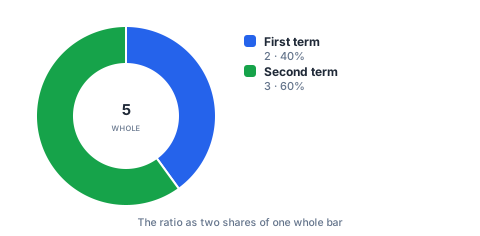
The first term and second term together form your simplified ratio, written as first:second. Like a simplified fraction, this is the smallest pair of whole numbers that still represents the exact same relationship as your original numerator and denominator.
If the GCD of your numbers is 1, the ratio is already in simplest form and will match your original numerator and denominator exactly.
Common fractions and their ratios
| Fraction | GCD | Ratio |
|---|---|---|
| 4/6 | 2 | 2:3 |
| 6/9 | 3 | 2:3 |
| 10/15 | 5 | 2:3 |
| 3/9 | 3 | 1:3 |
| 12/16 | 4 | 3:4 |
Notice the first three rows all simplify to the same 2:3 ratio — like equivalent fractions, different starting numbers can describe the same underlying relationship.
Where this comes up
Ratios show up anywhere two quantities are being compared directly rather than one being described as a share of a whole: mixing ratios for paint or concrete, aspect ratios for screens, and scale ratios on maps and models. If you actually need the fraction reduced to lowest terms rather than rewritten as a ratio, use the fraction simplifier instead — the math is identical, just the notation differs.
Part-to-part or part-to-whole?
This is where most ratio questions go wrong. Suppose a class has 8 boys and 12 girls. The ratio of boys to girls is
So a ratio of 2:3 does not mean “two-thirds are boys”. To turn a part-to-part ratio
Sharing a total in a given ratio
To split 40 sweets in the ratio 2:3, add the parts (
Ratios with decimals or fractions
A ratio should end up in whole numbers. Multiply both terms by the same number to clear decimals or fractions, then simplify:
: multiply by 2 to get . : multiply by 4 to get .
Common mistakes
- Swapping the order. “Boys to girls” is boys first.
and are different ratios. - Stopping too early.
divided by 2 gives , which still shares a factor. Divide by the GCD, 4, to land on in one step. - Mixing units. 50 cm to 2 m is not
. Convert first: . - Reading a ratio as a fraction of the whole. See the class example above.
Ratios with three parts
Ratios can compare more than two things, which fractions can’t do directly. A concrete mix of 12 kg cement, 18 kg sand and 30 kg gravel shares a GCD of 6:
Divide every term by the same number, just as with two terms.
Turning a ratio into percents
Add the parts to get the whole, then divide each part by it. For 2:3, the whole is 5 parts:
So a 2:3 mix is 40% of the first ingredient and 60% of the second. The percents always add to 100%.
Try these
| Fraction | Simplified ratio |
|---|---|
| 15/25 | 3:5 |
| 14/21 | 2:3 |
| 18/48 | 3:8 |
| 36/60 | 3:5 |
| 9/12 | 3:4 |
The ratio practice problems give unlimited extra questions.