
Two names for the same kind of number
Percent and parts per million are both ratios — a small amount measured against a whole. The only difference is the size of the “whole” each one references. Percent measures against 100; ppm measures against a million. So the same physical concentration comes out as a bigger, tidier number in ppm than in percent, and that’s the entire reason ppm exists as a unit.
A chlorine residual of 0.0002% and a chlorine residual of 2 ppm are identical. The second is the one a pool technician or a water operator actually writes down, because a string of leading zeros is an invitation to a decimal-point error.
The percent to ppm formula
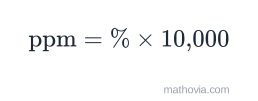
It falls straight out of the definitions. One percent is
Every percentage point contains 10,000 ppm. To reverse the conversion, divide ppm by 10,000.
Worked example
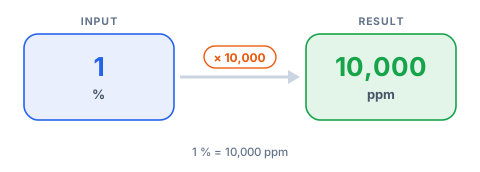
The calculator’s default is 1%.
A more typical trace-level case: a specification allows 0.05% of an impurity.
And going the other way, a lab reports 25 ppm of a contaminant:
Percent to ppm reference
| Percent | ppm | ppb |
|---|---|---|
| 10% | 100,000 | 100,000,000 |
| 1% | 10,000 | 10,000,000 |
| 0.5% | 5,000 | 5,000,000 |
| 0.1% | 1,000 | 1,000,000 |
| 0.01% | 100 | 100,000 |
| 0.001% | 10 | 10,000 |
| 0.0001% | 1 | 1,000 |
The bottom of the table is why the conversion is worth having: 0.0001% is barely legible, while 1 ppm is instantly clear.
Where this comes up
- Water treatment. Disinfectant residuals, fluoride, and hardness are dosed and reported in ppm (mg/L). A “0.0005% free chlorine” spec becomes a workable 5 ppm.
- Alloys and metallurgy. Trace carbon, sulfur, or phosphorus limits in steel are quoted in ppm; a mill certificate showing 0.025% sulfur is 250 ppm.
- Food and pharma. Additive and residual-solvent limits — 0.002% becomes 20 ppm.
- Gas detection. Workplace exposure limits for CO, H₂S, and solvent vapors are ppm figures; converting a “0.005%” atmosphere gives 50 ppm.
- Hydroponics and aquariums. Nutrient and salt concentrations are managed in ppm.
Mass basis versus volume basis
The multiply-by-10,000 step is the same no matter what your percentage measures. But the meaning carries through: a mass percent (grams of solute per 100 g of solution) converts to ppm by mass, which for water is the same as mg/L. A volume percent (mL per 100 mL) converts to ppm by volume, which is what gas concentrations use. The two are only interchangeable when you also bring in densities or molar volumes, so keep track of which basis your percentage started on.
Common mistakes
- Multiplying by 1,000,000 instead of 10,000. That’s the factor from a bare fraction to ppm, not from percent.
- Mixing a mass percent with a volume-based ppm limit, or vice versa.
- Dropping significant figures. A meter reading of 3 ppm recorded as 0.0003% can lose its last digit in a later rounding step.
For the reverse, use the ppm to percent converter. For finer scales, see ppm to ppb, and to build a ppm value from a measured mass and volume, the ppm calculator.
Very small percentages
Move the decimal point four places to the right. 0.0025% becomes 25 ppm, and 0.00008% becomes 0.8 ppm. When the result is below 1 ppm, switching to ppb is clearer: multiply the percent by 10,000,000, so 0.00008% is 800 ppb.
Making a solution from a percent concentrate
Household bleach is about 6% sodium hypochlorite, which is 60,000 ppm. To make 1 litre of a 200 ppm sanitising solution:
Make it up to 1 litre with water. That’s a dilution of about 1 part bleach to 300 parts water. Check the percentage on your own bottle, since bleach strengths vary between brands.