
What percent yield tells you
No reaction converts every molecule of starting material into the product you want and hands all of it back clean. Some of it reacts a different way, some never reacts at all, some sticks to the glassware or stays dissolved in the filtrate. Percent yield is the single number that captures how much of the theoretically possible product you actually walked away with.
A 100% yield is the unreachable ideal. Real chemistry lands below it, and the gap is diagnostic: a yield of 90% suggests minor handling losses, while 35% points to a sluggish reaction, a strong side pathway, or a workup that’s throwing product away.
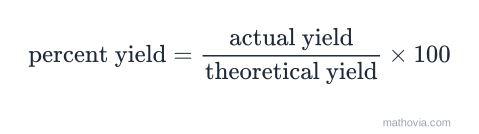
The percent yield formula
Both yields must be the same quantity in the same unit — normally the mass of product in grams. The theoretical yield is not something you weigh; it’s calculated from the limiting reagent through the balanced equation.
Worked example
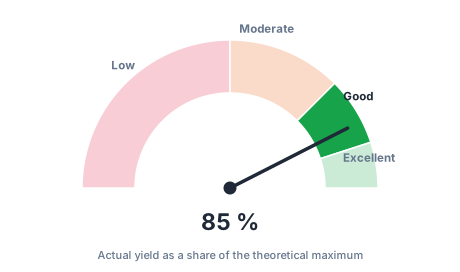
The calculator’s defaults are an actual yield of 8.5 g against a theoretical yield of 10 g.
The 1.5 g difference — the “amount lost” the calculator also reports — is product that theory predicted but the reaction and workup didn’t deliver.
Reading the number
| Percent yield | Typical interpretation |
|---|---|
| > 100% | product impure or wet; reweigh after drying |
| 90–100% | efficient reaction, minimal losses |
| 70–90% | normal for a well-behaved single step |
| 50–70% | acceptable for a demanding or multi-step reaction |
| < 50% | significant side reactions, incomplete conversion, or workup losses |
Where percent yield is used
- Lab reports and grading, where the calculation itself demonstrates you found the limiting reagent and did the stoichiometry.
- Reaction optimisation — changing temperature, solvent, catalyst, or stoichiometry and comparing yields.
- Process chemistry and scale-up, where a few percent of yield is worth real money.
- Overall yield of a synthesis — multiply the per-step yields; five steps at 80% each is only 0.8⁵ ≈ 33% overall.
Common mistakes
- Wrong theoretical yield — using the excess reagent instead of the limiting one, or skipping the mole ratio.
- Comparing mass to moles — convert both yields to the same basis first.
- Weighing wet product, which inflates the actual yield above 100%.
- Forgetting compounding when reporting an overall multi-step yield.
Calculate the theoretical yield first with the theoretical yield calculator. For the full reactant-to-product chain, see the stoichiometry calculator.
A full example: making aspirin
Aspirin (180.16 g/mol) is made from salicylic acid (138.12 g/mol) in a 1:1 ratio. A student starts with 2.00 g of salicylic acid, the limiting reagent, and collects 2.10 g of dry aspirin.
That’s a respectable result for a first-year lab, where losses during recrystallization usually keep yields between 60% and 85%.
Working backwards from a target
Percent yield also tells you how much to start with. To end up with 5.0 g of aspirin when you expect a 75% yield, first find the theoretical yield you need:
Plan for the yield you actually get, not the one on paper, or the batch comes up short.