
Same idea, opposite direction
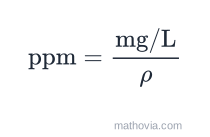
Lab instruments and discharge permits speak in milligrams per litre — a mass of solute per unit volume of solution. Many standards, specs, and older references speak in parts per million — a mass of solute per unit mass of solution. For water they’re numerically the same, because a litre of water weighs about a kilogram. For anything with a density noticeably different from 1 g/mL, converting mg/L to true ppm means dividing out that density.
The mg/L to ppm formula
where
Worked example
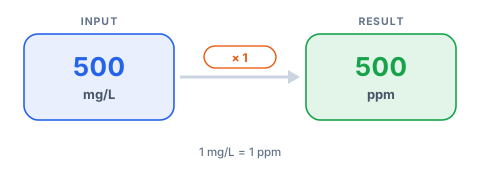
The calculator’s defaults are 500 mg/L in a solution of density 1 g/mL.
For seawater, density 1.025 g/mL:
A litre of seawater carries more mass than a litre of fresh water, so the same 500 mg spread through it is a slightly smaller fraction by mass.
How density changes the answer
| Solution | Density (g/mL) | 500 mg/L becomes |
|---|---|---|
| Fresh water | 1.000 | 500.0 ppm |
| Seawater | 1.025 | 487.8 ppm |
| 10% brine | 1.07 | 467.3 ppm |
| Saturated NaCl brine | 1.20 | 416.7 ppm |
| Ethanol | 0.789 | 633.7 ppm |
Notice ethanol, being lighter than water, pushes ppm above the mg/L figure.
Where this comes up
- Regulatory compliance. A permit limit stated in mg/L versus a historical dataset in ppm — reconciling them for a dense effluent needs the density term.
- Desalination and produced water. High-TDS streams where the density is well above 1.
- Fuel and lubricant analysis. Water content and additive levels in hydrocarbons, densities around 0.75–0.90.
- Concentrated reagent prep. Converting a target mg/L into the mg/kg you actually weigh out.
Common mistakes
- Assuming mg/L = ppm for every liquid. It’s a water-only shortcut.
- Using solvent density rather than solution density.
- Forgetting temperature shifts density slightly, and with it the conversion.
For the reverse, use the ppm to mg/L converter. For other units, see the ppm converter.
Working backwards: ppm to mg/L
Multiply instead of divide. A brine with density 1.20 g/mL holding 1,000 ppm of a dissolved metal contains:
The dense brine packs 1.2 kg into each litre, so the same mass fraction means more milligrams per litre.
A low-density example: water in diesel
Diesel has a density of about 0.84 g/mL. A lab reports 50 mg/L of water in a fuel sample. As a mass fraction:
Here ppm comes out higher than mg/L, because a litre of diesel weighs less than a kilogram. Fuel specifications quote water limits in mg/kg, so this is the number to compare against the spec.
Finding the density
- Look it up for common liquids: seawater about 1.025 g/mL, diesel about 0.84, ethanol 0.789 at 20 °C.
- Measure it with a hydrometer, or weigh a known volume: 250 mL that weighs 262 g has a density of
g/mL. - Ignore it for drinking water and other dilute aqueous samples. The density is within about 0.3% of 1, smaller than most measurement error.