

One concentration, many labels
Parts per million is the default unit for trace amounts, but different fields dress the same number in different clothes. An environmental report wants a percentage. A toxicologist wants ppb. A food scientist writes mg/kg. A water-treatment operator uses mg/L. They are all describing the identical concentration, and this converter lays them out side by side.
The relationships never change:
- ppm = mg/kg = µg/g = ng/mg — all mass-per-mass, all numerically identical.
- ppm = mg/L only for water and dilute aqueous solutions, where a litre weighs a kilogram.
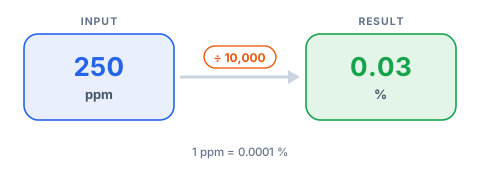
- percent = ppm ÷ 10,000, always.
- ppb = ppm × 1,000 and ppt = ppm × 1,000,000, always.
Learn any one value and the rest follow.
The conversion formulas
Worked example
The calculator’s default is 250 ppm.
So 250 ppm of a substance in water is 0.025%, 250,000 ppb, and 250 mg/L — different notations, one physical fact.
The full ladder
| Unit | Value for 250 ppm | Relationship to ppm |
|---|---|---|
| Percent | 0.025% | ÷ 10,000 |
| ppm | 250 | — |
| ppb | 250,000 | × 1,000 |
| ppt | 250,000,000 | × 1,000,000 |
| mg/kg | 250 | identical |
| µg/g | 250 | identical |
| mg/L (water) | 250 | identical for water only |
Where each unit lives
- Percent — bulk composition, alloy grades, nutrition labels.
- ppm — drinking-water hardness and chlorine, soil nutrients, indoor CO₂, welding shield-gas purity.
- ppb — regulated contaminants: lead, arsenic, pesticides, air-quality ozone.
- ppt — dioxins, PFAS in some frameworks, semiconductor chemical purity.
- mg/L — the working unit of water and wastewater labs.
Common mistakes
- Treating mg/L as ppm for a non-water solution. Bring in the density.
- Confusing ppb with ppt — a factor of 1,000 that has changed the meaning of a regulatory number more than once.
- Assuming a gas-phase ppm (by volume) equals a liquid ppm (by mass).
For the individual conversions, see ppm to percent, ppm to ppb, and ppm to mg/L. To compute ppm from a measured part and whole, use the ppm calculator.
Percent and ppm in both directions
Because percent is parts per hundred and ppm is parts per million, the gap between them is a factor of 10,000. Going up, multiply; going down, divide.
A useful anchor: 1% is 10,000 ppm. Anything above about 10,000 ppm reads more naturally as a percent, and anything below about 0.01% reads more naturally in ppm.
Gas concentrations: ppm by volume
In air, ppm almost always means parts per million by volume (ppmv). To turn it into a mass concentration in mg/m³, you need the gas’s molar mass
For carbon monoxide (
This is why gas-phase ppm can’t be swapped for mg/kg or mg/L the way water ppm can. The conversion depends on which gas it is, and on temperature and pressure.