
Two units that usually agree, and sometimes don’t
In everyday water work, ppm and mg/L get used as if they were the same thing, and for tap water they effectively are. But they measure different quantities. Parts per million is a mass ratio — milligrams of solute per kilogram of solution. Milligrams per litre is a mass concentration — milligrams of solute per litre of solution. The bridge between “per kilogram” and “per litre” is the solution’s density, and only when that density is exactly 1 g/mL do the two numbers coincide.
Water sits at almost exactly 1 g/mL, so the shortcut holds. Step outside dilute water — into seawater, a concentrated acid, a sugar syrup, a solvent — and the density correction becomes a real source of error if you skip it.
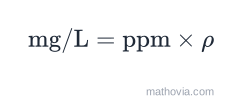
The ppm to mg/L formula
where
Worked example
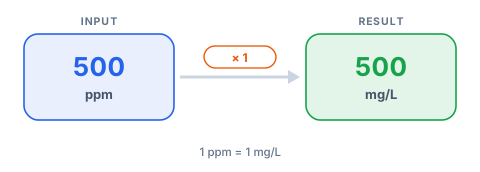
The calculator’s defaults are 500 ppm in a solution of density 1 g/mL.
Now the same 500 ppm dissolved in seawater, density 1.025 g/mL:
Every litre of seawater carries about 2.5% more mass than a litre of pure water, so the same mass ratio corresponds to a higher mass-per-volume figure.
How density shifts the result
| Solution | Density (g/mL) | 500 ppm becomes |
|---|---|---|
| Fresh water | 1.000 | 500.0 mg/L |
| Seawater | 1.025 | 512.5 mg/L |
| 10% brine | 1.07 | 535.0 mg/L |
| Saturated NaCl brine | 1.20 | 600.0 mg/L |
| Ethanol | 0.789 | 394.5 mg/L |
Where the distinction matters
- Regulatory reporting. Discharge permits and drinking-water standards are written in mg/L; a lab result in ppm has to be converted correctly, density included, for a dense effluent.
- Petroleum and process chemistry. Water-in-oil or additive concentrations in fuels and lubricants involve densities well away from 1.
- Brine and desalination. High-salinity streams need the density term or the mass balance won’t close.
- Lab prep. Making a standard “500 mg/L” solution in a non-aqueous solvent means weighing to a different number than 500 mg/kg would give.
Common mistakes
- Assuming ppm = mg/L for every liquid. True for water only.
- Using the solvent’s density instead of the finished solution’s.
- Ignoring temperature when high precision matters — it moves the density a little.
For the reverse, use the mg/L to ppm converter. For other scales, see the ppm converter, and to compute ppm from a measured mass and volume, the ppm calculator.
A dense-solution example
A sugar syrup has a density of about 1.10 g/mL. A preservative at 2,000 ppm by mass in that syrup works out to:
That’s 2.2 g in every litre. Treating it as 2,000 mg/L would underdose a batch by about 9%.
Measuring the density yourself
If you can’t look up the density, measure it: weigh an empty container, add exactly 100 mL of the solution, and weigh again. If the solution weighs 107.5 g, the density is
Moving to other units
Once you have mg/L, related units follow by powers of 1,000:
- 2,200 mg/L = 2.2 g/L.
- 2,200 mg/L = 2,200,000 µg/L.
- 1 mg/L = 1 g/m³, since a cubic metre is 1,000 litres.