
What you’re actually converting
Parts per billion and parts per million are the same kind of measurement — a ratio of one substance to the whole — just pinned to different reference sizes. One ppm is one unit in a million; one ppb is one unit in a billion. Since a billion is a thousand millions, every ppm is worth 1,000 ppb, and the conversion is a single division.
The reason both units exist is readability. Water utilities report lead at 15 ppb, arsenic at 10 ppb, and some disinfection by-products in the low single digits. Written in ppm those become 0.015, 0.010, and 0.002 — strings of leading zeros that invite a misplaced decimal on a lab bench or in a spreadsheet. PPB keeps the significant figures in front where a person can read them at a glance. PPM, meanwhile, stays the natural unit for things present in larger amounts: water hardness, nitrate, chloride, dissolved oxygen, pool chlorine.
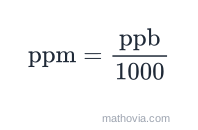
The ppb to ppm formula
It comes straight out of the definitions. Expressed as fractions, 1 ppb is
One ppb is a thousandth of a ppm. To go the other way — ppm back to ppb — multiply by 1,000 instead.
Worked example
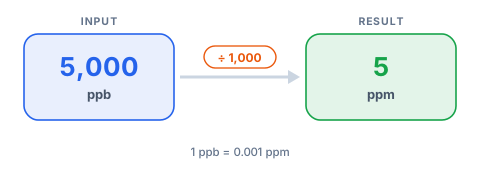
Start with the calculator’s default of 5,000 ppb.
For a water sample, that same concentration can be written a third way. Because one liter of water weighs almost exactly one kilogram — a billion micrograms — a concentration of 5,000 ppb by mass is also 5,000 µg/L, which is 5 mg/L, which is 5 ppm. All four labels describe the identical sample:
A regulatory example runs the other direction. The EPA action level for lead is 15 ppb. Divide by 1,000 and that is 0.015 ppm, or 0.015 mg/L — the same limit, just less pleasant to read.
Common limits in both units
| Substance (drinking water) | Limit | In ppm |
|---|---|---|
| Lead (EPA action level) | 15 ppb | 0.015 ppm |
| Arsenic (MCL) | 10 ppb | 0.010 ppm |
| Total mercury (MCL) | 2 ppb | 0.002 ppm |
| Atrazine (MCL) | 3 ppb | 0.003 ppm |
| Nitrate as N (MCL) | 10,000 ppb | 10 ppm |
| Copper (action level) | 1,300 ppb | 1.3 ppm |
Notice nitrate: its limit is high enough that nobody writes it as 10,000 ppb. It lives in ppm. The trace metals above it live in ppb. The unit a lab picks is a hint about the scale of what’s being measured.
Reading the other results
The calculator also shows a percent value. Percent is parts per hundred, so it sits eight orders of magnitude above ppb — 5,000 ppb is 0.0005%. Percent is almost never the right unit for a trace contaminant; it’s shown mainly so you can sanity-check a value that was handed to you in the wrong unit.
The mg/L field assumes the solution is water or close to it in density. For a dilute aqueous sample, mg/L and ppm are interchangeable. For a concentrated brine, a solvent other than water, or a gas, that shortcut fails and you need the actual density or the molar-volume conversion. See the ppm to mg/L converter for the reverse, and the ppm calculator to build a ppm value from a mass and a volume directly.
Mistakes that happen a lot
- Dividing by the wrong power of ten. ppb to ppm is ÷1,000, not ÷100 or ÷1,000,000. Dividing by a million confuses ppb with ppt (parts per trillion).
- Assuming ppb always equals µg/L. True for water within a percent or two. Not true for seawater, syrups, organic solvents, or air.
- Mixing a mass basis with a volume basis. Water-quality ppb is by mass; air-quality ppb is usually by volume. They are not directly comparable without a density or molar-mass step.
- Losing the significant figures. If a meter reads 3 ppb and you record 0.003 ppm, a later rounding step can quietly drop it to 0.00 ppm. Keep the value in the unit it was measured in.
Where this shows up
Annual drinking-water quality reports (the “Consumer Confidence Report” every US utility mails out) mix ppb and ppm line by line, and comparing your result to the limit means getting both into the same unit first. Beyond that: aquarium and hydroponic nutrient dosing, swimming-pool and spa chemistry, soil and tissue lab results in agriculture, semiconductor process-water specs, and environmental site assessments all move between ppb and ppm routinely.