
Why step down to parts per billion
Parts per billion is parts per million with three more zeros of resolution. It’s the unit you reach for when the concentrations that matter are small fractions of a ppm. A drinking-water lab reporting lead at 0.012 ppm is really saying 12 ppb, and the ppb form is the one that appears in the regulation, on the meter, and in the report — because “12” carries its significant figures out front where a person can read them, and “0.012” hides them behind a decimal point.
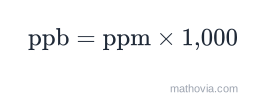
The ppm to ppb formula
One ppm is a millionth (
so one ppm is a thousand ppb. To reverse, divide ppb by 1,000.
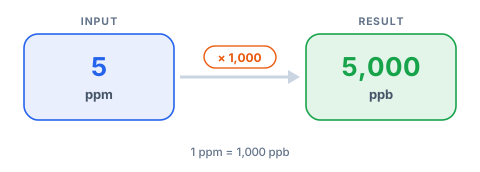
Worked example
The calculator’s default is 5 ppm.
For a water sample, 5 ppm by mass is also 5,000 µg/L and 5 mg/L — the same concentration in three notations. A regulatory example runs the other way: the arsenic maximum contaminant level is 0.010 ppm, which the rule states as 10 ppb.
Regulatory limits are usually ppb
| Substance (drinking water) | Limit in ppm | In ppb |
|---|---|---|
| Lead (EPA action level) | 0.015 | 15 |
| Arsenic (MCL) | 0.010 | 10 |
| Total mercury (MCL) | 0.002 | 2 |
| Atrazine (MCL) | 0.003 | 3 |
| Benzene (MCL) | 0.005 | 5 |
| Copper (action level) | 1.3 | 1,300 |
Nitrate, by contrast, has an MCL of 10 ppm — 10,000 ppb — and nobody writes it in ppb. The unit a standard uses is a hint about the scale of the hazard.
Where ppb shows up
- Drinking-water compliance. The annual Consumer Confidence Report every US utility issues lists trace metals and organics in ppb.
- Environmental site assessment. Soil and groundwater contamination limits for solvents and metals are ppb-scale.
- Air quality. Ozone and nitrogen dioxide standards are stated in ppb by volume.
- Pharmaceutical impurities. Genotoxic-impurity limits in drug substances are often single-digit ppb.
Common mistakes
- Multiplying by 1,000,000 (that’s the step to parts per trillion) or by 100.
- Assuming ppb equals µg/L for any solution. True for water; not for brine, oil, or gas.
- Mixing a mass-basis water ppb with a volume-basis air ppb in the same comparison.
For the reverse, use the ppb to ppm converter. For the percentage form, see ppm to percent, and for mass-per-volume, ppm to mg/L.
Going down to ppb, and back up
Each step down the ladder multiplies by 1,000, and each step up divides by 1,000:
A quick check: the number in ppb should always be bigger than the same value in ppm, because the parts are smaller.
Reading a water report
Lab results are often printed in mg/L with several leading zeros, while limits are stated in µg/L or ppb. For water, mg/L equals ppm and µg/L equals ppb, so a lead result of 0.0042 mg/L converts as:
Moving the decimal point three places to the right is all it takes, and it’s much easier to compare 4.2 with a limit than to count zeros.
How small is a part per billion?
Time makes a good yardstick. One part per million is about one second in 11.6 days. One part per billion is about one second in 32 years. That gap of a thousand is why a contaminant can be harmless at a few ppm in one context and regulated at a few ppb in another.