
Dilution ratios are where good products get wasted. Pour too much concentrate and you burn money, leave residue, and can damage the surface you were trying to protect; pour too little and the cleaner, coolant, or fertilizer simply does not work. The math is a single division, but the part that trips people up is what the ratio label actually means, since 1:10 is printed on bottles that intend two different mixes.
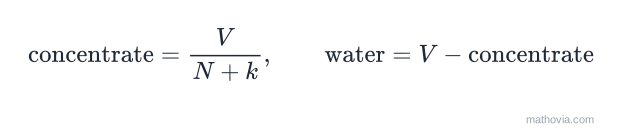
The dilution ratio formula
For a ratio written 1:N and a finished batch of volume
where
How to Calculate a Dilution Ratio (step by step)
Step One: Turn the ratio into total parts
A ratio of 1:N is a recipe in “parts.” How many parts end up in the bottle depends on the convention printed on the label.
Total parts = N + 1        (when the ratio is concentrate : water)
Total parts = N            (when the ratio is concentrate : finished mix)
Ratio = 1:10, read as concentrate : water
Total parts = 10 + 1 = 11
Step Two: Divide the batch size by total parts
One of those parts is concentrate, so dividing the finished volume by total parts gives the concentrate dose.
Concentrate = Batch size ÷ Total parts
Concentrate = 32 ÷ 11 = 2.91 fl oz
Step Three: Subtract to find the water
Water fills the remaining parts. Never add N parts of water to a full batch already sized for the finished volume, or you overfill.
Water = Batch size − Concentrate
Water = 32 − 2.91 = 29.09 fl oz
Step Four: Express it as a percent and a per-gallon dose
Percent strength lets you compare two ratios instantly, and the per-gallon figure is what most bucket and sprayer instructions use.
Concentration % = 100 ÷ Total parts
Concentrate per gallon = 128 ÷ Total parts
Concentration = 100 ÷ 11 = 9.09%
Per gallon = 128 ÷ 11 = 11.64 fl oz
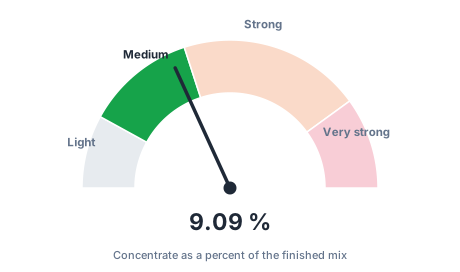
What your results mean
For a 32 fl oz spray bottle at 1:10, you pour 2.91 fl oz of concentrate and 29.09 fl oz of water for a 9.09% solution, equal to 11.64 fl oz per gallon. The strength band flags that as moderate, heavy-duty cleaning territory, not a daily wipe-down mix.
Reading ratios on real labels
| Label text | Interpretation | Total parts | Strength |
|---|---|---|---|
| “1:10 with water” | concentrate : water | 11 | 9.09% |
| “1:10 solution” | concentrate : finished mix | 10 | 10.00% |
| “10% solution” | concentrate : finished mix | 10 | 10.00% |
The gap looks trivial at 1:10 and it is, roughly 9% of a bottle. At 1:1 it is the difference between a 50% mix and a 100% mix, so the tighter the ratio, the more the convention matters.
Practical tips
Measure the concentrate, not the water. Small errors in a 2.91 fl oz dose matter far more than the same error in 29 fl oz. Use a graduated cylinder or a marked dosing cap rather than eyeballing a bottle neck, and mark the fill line on reusable bottles once so the next mix takes ten seconds. If you are diluting from an already-diluted stock, run the numbers twice: ratios multiply, so 1:10 of a 1:10 stock is 1:120 relative to neat concentrate, not 1:20.
Common ratios and their strength
| Ratio (conc : water) | Total parts | Concentration | Oz per US gallon |
|---|---|---|---|
| 1:4 | 5 | 20% | 25.6 |
| 1:10 | 11 | 9.09% | 11.6 |
| 1:20 | 21 | 4.76% | 6.1 |
| 1:32 | 33 | 3.03% | 3.9 |
| 1:64 | 65 | 1.54% | 2.0 |
| 1:128 | 129 | 0.78% | 1.0 |
| 1:256 | 257 | 0.39% | 0.5 |
The 1:128 line is a handy anchor: it works out to almost exactly one fluid ounce per gallon, which is why so many concentrated cleaners are formulated to that ratio.
Where dilution ratios come up
- Janitorial and automotive cleaners — degreasers, all-purpose sprays, and car-wash soap are all sold concentrated and diluted at the point of use.
- Coolant and antifreeze — engine coolant is typically a 1:1 mix with distilled water, and the ratio sets the freeze and boil protection.
- Garden and agriculture — liquid fertilizers, herbicides, and pesticides are dosed per gallon or per tank, and over-concentration burns plants.
- Photography and lab work — developer and fixer stock solutions, and preparing working standards from a concentrated stock.
- Food service — sanitizer solutions mixed to a target ppm, where the dilution ratio and the concentrate strength together set the final concentration.
Common mistakes
- Misreading the ratio convention — the difference between “1:10 with water” and “1:10 solution” is 9% versus 10%, small at wide ratios but large at tight ones.
- Adding N parts of water to a full finished batch, which overfills.
- Compounding a dilution without multiplying the ratios.
- Eyeballing the concentrate instead of measuring it precisely.
For turning a target concentration into a dilution factor the other way, see the dilution work in the molarity calculator for lab solutions.