
When a ppm value wants to be a percent
Parts per million is built for small numbers. Once a concentration climbs past a thousand ppm or so, the ppm figure gets long and a percentage reads better: “35,000 ppm” is how seawater salinity might come out of a formula, but “3.5%” is how anyone actually describes it. Converting ppm to percent is a single division, and it’s the right move whenever the audience or the context expects a percentage.
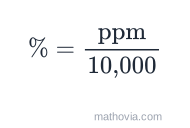
The ppm to percent formula
Percent is parts per hundred, ppm is parts per million, and a million is ten thousand hundreds — so ten thousand ppm make up one percent. To go the other way, multiply percent by 10,000.
Worked example
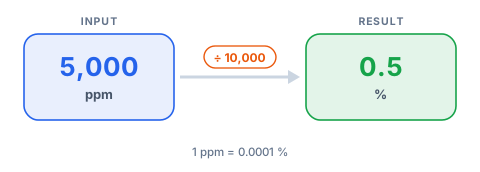
The calculator’s default is 5,000 ppm.
So 5,000 ppm is a 0.5% concentration. As a plain decimal fraction that’s 0.005 (ppm ÷ 1,000,000), and in finer units it’s 5,000,000 ppb.
A larger example: a brine measured at 30,000 ppm total dissolved solids.
ppm to percent reference
| ppm | Percent | As a fraction |
|---|---|---|
| 1 | 0.0001% | 0.000001 |
| 100 | 0.01% | 0.0001 |
| 1,000 | 0.1% | 0.001 |
| 5,000 | 0.5% | 0.005 |
| 10,000 | 1% | 0.01 |
| 50,000 | 5% | 0.05 |
| 100,000 | 10% | 0.1 |
Where the conversion is useful
- Salinity and TDS. Water-quality meters read total dissolved solids in ppm; describing a source as “0.8% TDS” is clearer to a non-specialist.
- Cleaning and dosing solutions. A sanitizer dosed at 2,000 ppm is a 0.2% solution — the figure you’d put on a label.
- Soil and fertilizer. Nutrient analyses come in ppm; agronomic recommendations are often stated as a percentage of dry matter.
- Industrial specs. A maximum moisture content of 500 ppm in a solvent is 0.05% — the way a purchasing spec might phrase it.
Mass basis versus volume basis
Dividing by 10,000 works regardless of what the ppm measures, but the result inherits the basis. A ppm-by-mass (mg/kg) becomes a mass percent; a ppm-by-volume, common for gases, becomes a volume percent. Don’t compare a mass percent from one source against a volume percent from another without converting through densities.
Common mistakes
- Dividing by 1,000,000 instead of 10,000. That gives the bare fraction, not the percentage.
- Losing precision on very small values. 3 ppm is 0.0003% — easy to round away to zero in a later step.
- Switching basis silently between mass and volume when moving between sources.
For the reverse, use the percent to ppm converter. For finer scales, see ppm to ppb, and for the mass-per-volume form, ppm to mg/L.
Salinity in both units
Water salinity is a good place to see the two scales side by side:
| Water | ppm (TDS) | Percent |
|---|---|---|
| Typical drinking water | 50–500 | 0.005–0.05% |
| Brackish water | 1,000–10,000 | 0.1–1% |
| Seawater | about 35,000 | about 3.5% |
| Dead Sea | about 340,000 | about 34% |
Below about 1,000 ppm the percent figures start collecting leading zeros, which is why drinking-water reports stay in ppm.
Making a solution to a target percent
Converting the other way helps when you’re mixing. A 0.9% saline solution is 9,000 ppm by mass, which is 9 g of salt per kilogram of solution. Dissolve 9 g of sodium chloride and make it up to 1 kg (very close to 1 L) with water.