
What ppm measures
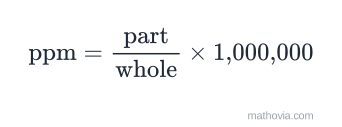
Parts per million answers a simple question: out of a million equal parts of the whole mixture, how many are the substance you care about? It’s a fraction, scaled up by a million instead of by a hundred the way percent is. That scaling is the whole point — trace concentrations that would be unreadable strings of zeros in percent become clean two- and three-digit numbers in ppm. A drinking-water chlorine residual of 0.0002% is the same thing as 2 ppm, and 2 ppm is what gets written on the log sheet.
The ppm formula
The “part” is the amount of the substance; the “whole” is the total amount of mixture, solute included. Both must be in the same unit — grams with grams, milligrams with milligrams, millilitres with millilitres — because ppm is a pure ratio with the units cancelling out.
Worked example
The calculator’s defaults are a part of 5 and a whole of 1,000,000.
A real-world version: a 500 g water sample is found to hold 0.025 g of dissolved salt.
And in the other direction — how much solute is in a known volume at a known ppm? For 400 ppm in 2 L of water (2,000 g):
Reading ppm at a glance
| part in whole | ppm | as percent |
|---|---|---|
| 1 g in 1,000,000 g | 1 | 0.0001% |
| 1 mg in 1 kg | 1 | 0.0001% |
| 1 g in 1 kg | 1,000 | 0.1% |
| 1 mL in 1,000 L | 1 | 0.0001% |
| 1 teaspoon in 1,300 gallons | ≈ 1 | 0.0001% |
Where the calculation is used
- Water testing. Hardness, chloride, nitrate, and disinfectant residuals from a measured solute mass and sample size.
- Hydroponics and aquariums. Dosing nutrients or salts to a target ppm in a known tank volume.
- Food and beverage. Additive and preservative levels against a batch weight.
- Soil and agriculture. Element concentrations from a lab digestion.
- Air quality. Contaminant volume in a sampled air volume (a by-volume ppm).
Common mistakes
- Mismatched units — dividing milligrams by litres. Convert first, or treat the water as 1 g/mL on purpose.
- Using solvent mass as the whole instead of total solution mass. Fine when dilute, wrong when concentrated.
- Multiplying by 100 (that’s percent) or by 1,000 (that’s per-thousand).
For converting an existing ppm figure into other units, use the ppm converter. For the mass-per-volume form, see ppm to mg/L.
Dosing to a target ppm
Rearranging the formula tells you how much to add. A hydroponic reservoir holds 20 L of water (20,000 g) and needs 150 ppm of nitrogen:
If the fertilizer is 20% nitrogen by mass, you need
Diluting a stock solution
To make a weaker solution from a stronger one, use
Measure 10 mL of stock and top it up to 500 mL with water. For a big dilution like this, doing it in two steps (1,000 to 100, then 100 to 20) is usually more accurate than pipetting a tiny volume.
ppm in air
For gases, ppm is by volume. Outdoor carbon dioxide at about 420 ppm means 420 mL of CO₂ in every cubic metre of air, since one cubic metre is 1,000,000 mL. Indoor readings above about 1,000 ppm are a common sign that a room needs more ventilation.