
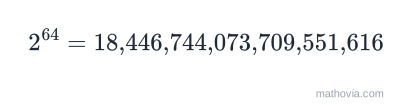
Ordinary calculators quietly give up somewhere around the 16th digit. Type 2^64 into a phone, spreadsheet or browser console and you get 18446744073709552000, a number that looks precise but has its last four digits wrong. This large number calculator keeps every digit exact, however long the number gets, so you can multiply 30-digit numbers, take factorials, work out huge powers or check a cryptography homework problem and trust the answer to the last place.
Why normal calculators round big numbers
Almost every calculator, spreadsheet and programming language stores numbers in a format called double-precision floating point. It’s fast and handles a huge range, from 10^-308 to 10^308, but it only keeps about 15 to 17 significant digits. Everything after that is approximated.
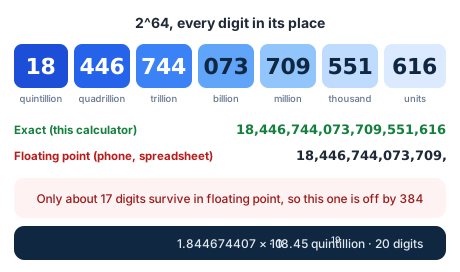
The cleanest way to see it is the number 2^53, which is 9,007,199,254,740,992. Below it, every whole number is stored exactly. Above it, gaps appear. Ask a normal calculator for 2^53 + 1 and it answers 9,007,199,254,740,992, the same number, because the + 1 has nowhere to go. Here’s the chessboard number done both ways:
floating point:   18,446,744,073,709,552,000
exact:            18,446,744,073,709,551,616
That error of 384 doesn’t matter for a shopping bill. It matters a lot for account numbers, cryptographic keys, combinatorics and any problem where the last digit is the answer.
How to calculate with large numbers (step by step)
The calculator opens on the wheat and chessboard problem. One grain of wheat goes on the first square of a chessboard, two on the second, four on the third, doubling each time. How many grains does the whole board hold?
Step One: Enter the numbers
Type or paste A and B. Commas, spaces and underscores are ignored, so 1,000,000 and 1 000 000 both work, and so does e-notation like 6.022e23.
A = 2
B = 64
Step Two: Pick the operation
Square 1 holds 2^0 = 1 grain and square 64 holds 2^63. Adding up a doubling series like 1 + 2 + 4 + … + 2^63 always gives one less than the next power of two, so the board’s total is 2^64 − 1. Start with the power:
Operation: Power (A^B) → 2^64
Step Three: Read the exact result and its size
2^64 = 18,446,744,073,709,551,616
scientific notation: 1.844674407 × 10^19
in words: 18.45 quintillion
digits: 20
Step Four: Subtract 1 for the board’s total
Paste the result into A, switch to Subtract and set B to 1.
18,446,744,073,709,551,616 − 1 = 18,446,744,073,709,551,615 grains
That’s about 18.45 quintillion grains, more wheat than the world has ever harvested. The same number, 2^64 − 1, is the largest value a 64-bit unsigned integer can hold, which is why it shows up in computing so often.
Multiplying two huge numbers
Multiplication is where a normal calculator fails fastest, because the digit count roughly adds up. Two 30-digit numbers give a 59- or 60-digit product:
123,456,789,012,345,678,901,234,567,890
× 987,654,321,098,765,432,109,876,543,210
= 121,932,631,137,021,795,226,185,032,733,622,923,332,237,463,801,111,263,526,900
A floating-point calculator would show 1.2193263113702178e59, keeping 17 digits and throwing away the other 43.
Names of large numbers
The calculator names any result up to the vigintillions, plus the googol and the centillion. These are short-scale names, the system used in the US and in modern British English, where each new name is a thousand times the previous one.
| Name | Power of ten | Zeros |
|---|---|---|
| Million | 10^6 | 6 |
| Billion | 10^9 | 9 |
| Trillion | 10^12 | 12 |
| Quadrillion | 10^15 | 15 |
| Quintillion | 10^18 | 18 |
| Sextillion | 10^21 | 21 |
| Septillion | 10^24 | 24 |
| Octillion | 10^27 | 27 |
| Nonillion | 10^30 | 30 |
| Decillion | 10^33 | 33 |
| Vigintillion | 10^63 | 63 |
| Googol | 10^100 | 100 |
| Centillion | 10^303 | 303 |
Older British usage (the long scale) made a billion a million million, 10^12. If you’re reading an old text and the numbers seem a thousand times too large, that’s probably why.
Factorials, powers and roots
Factorials grow faster than anything else on the calculator. 25! is 15,511,210,043,330,985,984,000,000, 26 digits from multiplying just 25 numbers. 52!, the number of ways to shuffle a deck of cards, is about 8.07 × 10^67, a 68-digit number. That’s so large that a properly shuffled deck has almost certainly never been in that order before. Factorials are also what sit behind combinations, which you can see at work in the binomial distribution calculator.
Powers follow the usual exponent rules: a negative exponent gives a reciprocal, so 2^-3 = 0.125, and anything to the power 0 is 1. The exponent has to be a whole number, since a fractional power like 2^0.5 is really a root.
Square roots and division run to as many decimal places as you ask for, up to 1,000. 1 ÷ 7 to 30 places is 0.142857142857142857142857142857, showing the repeating block 142857, and √2 to 30 places is 1.414213562373095048801688724210 (the calculator drops that final 0).
Mod, GCF and LCM for big integers
Modular arithmetic is the quiet workhorse behind check digits and encryption. International bank account numbers (IBANs), for example, are validated by turning the account into a long integer and checking that it leaves a remainder of 1 when divided by 97. With this calculator, 123456789012345678901234567890 mod 97 = 52. The remainder is always given as a non-negative number, so -7 mod 3 = 2. That’s the convention used in number theory, though some programming languages return -1 instead.
The greatest common factor and least common multiple work on integers of any size. For small numbers they’re the same tools used to simplify fractions and find common denominators. The least common denominator calculator applies the LCM to fractions directly.
Common mistakes with big numbers
- Trusting a spreadsheet past 15 digits. Excel stores a 16-digit card or account number with its last digit replaced by 0. Store such values as text, or check them here.
- Confusing 2^64 with 2^64 − 1. The board total, and the 64-bit maximum, is one less than the 64th power.
- Mixing up billion scales. A “billion” in an old British source may mean 10^12, not 10^9.
- Using a decimal exponent. 10^2.5 isn’t a power this calculator does. Rewrite it as a root, or use a scientific calculator for an approximate answer.
- Forgetting how fast factorials grow. 70! is already past a googol. If a problem seems to need 1000!, there’s usually a smarter route, such as cancelling factors first.
For everyday sums that fit comfortably in 12 digits, the 4 function calculator is quicker to use.