
Negative numbers are where a lot of people’s confidence with arithmetic quietly falls apart. The operations aren’t any harder, but the signs follow rules that feel arbitrary until you’ve seen why they work. This calculator handles any pair of integers and shows its reasoning, so you can check homework, see where an answer went wrong, or just trust a bank balance that dipped below zero.

The integer rules in one place
Every integer problem uses one of a handful of rules. Subtraction gets converted into addition first, so in practice you only need two sets: one for adding and one for multiplying or dividing.
| Operation | Signs | What to do | Example |
|---|---|---|---|
| Add | same | Add the absolute values, keep the sign | -8 + (-3) = -11 |
| Add | different | Subtract the absolute values, take the sign of the larger one | 5 + (-12) = -7 |
| Subtract | any | Add the opposite, then use the addition rules | -8 - (-3) = -8 + 3 = -5 |
| Multiply | same | Positive | (-7) × (-6) = 42 |
| Multiply | different | Negative | (-7) × 6 = -42 |
| Divide | same | Positive | (-24) ÷ (-6) = 4 |
| Divide | different | Negative | (-24) ÷ 6 = -4 |
The absolute value is just the distance from zero, with the sign stripped off. The absolute value of -8 is 8, and the absolute value of 8 is 8 too.
How to subtract integers (step by step)
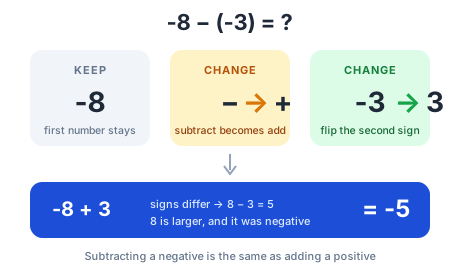
The calculator opens on the problem that trips up the most students: -8 - (-3). Two minus signs in a row look like they should cancel into something negative, and they don’t.
Step One: Rewrite the subtraction as adding the opposite
Teachers call this “keep, change, change”. Keep the first number, change the operation to addition, and change the sign of the second number.
a − b = a + (−b)
-8 − (-3) = -8 + 3
Step Two: Compare the signs
-8 is negative and 3 is positive. Different signs mean you’re really finding the distance between two absolute values.
different signs → subtract the absolute values
8 − 3 = 5
Step Three: Give the answer the sign of the larger absolute value
8 is bigger than 3, and the 8 came from -8, so the answer is negative.
-8 − (-3) = -5
On a number line, you start at -8 and move 3 to the right, which lands you on -5. That’s the picture the calculator draws under the result, and it’s a quick sanity check. Adding a positive always moves right, adding a negative always moves left.
Adding integers with the same or different signs
With the same signs, nothing tricky happens. Add the sizes and keep the sign. Two debts of $8 and $3 make a debt of $11, so -8 + (-3) = -11.
-8 + (-3): same signs → 8 + 3 = 11 → keep the minus → -11
With different signs, the two numbers pull in opposite directions, and the stronger one wins. Have $5 and owe $12 and you’re $7 short.
5 + (-12): different signs → 12 − 5 = 7 → 12 is larger, so negative → -7
When the absolute values match, the numbers are opposites and cancel to zero: -15 + 15 = 0.
Multiplying and dividing integers
These are easier than they look, because the size and the sign are separate questions. First do the arithmetic as though both numbers were positive. Then count the negative signs.
(-7) × (-6):  7 × 6 = 42 → two negatives (same signs) → +42
(-24) ÷ 6:    24 ÷ 6 = 4 → one negative (different signs) → -4
This extends to long chains. An even number of negative factors gives a positive product, and an odd number gives a negative one. So (-2) × (-3) × (-1) = -6, since three negatives is odd.
Division has one wrinkle that multiplication doesn’t. Two integers don’t always divide evenly. -7 ÷ 2 is -3.5, and -7 ÷ (-3) is 7/3, a repeating decimal (about 2.3333). The calculator tells you when this happens, simplifies the fraction, and shows the remainder, since some textbooks want the answer as “2 remainder 1” instead. If you need to tidy up a fraction result further, the fraction simplifier does the reducing step on its own.
Why a negative times a negative is positive
This is the rule people most often memorise without believing. Here’s the cleanest argument. Look at a pattern where one factor drops by 1 each line:
3 × (-4) = -12
2 × (-4) = -8
1 × (-4) = -4
0 × (-4) =  0
(-1) × (-4) = ?
Each time the first number goes down by one, the answer goes up by 4. Continuing the pattern, the next line has to be +4. Any other answer would break the pattern, and with it the distributive law that the rest of algebra depends on.
Where integers show up outside class
Temperatures are the classic case. If it’s -8°F at dawn and warms by 15 degrees, it’s 7°F, which is -8 + 15. Bank accounts, golf scores, elevations below sea level and yardage lost in football all work the same way. Any time a quantity can fall below a starting line, you’re doing integer arithmetic, whether or not you call it that.
Negative numbers and exponents
Exponents add one more trap, and it’s about brackets rather than sign rules:
(−3)² = (−3) × (−3) = 9
−3²   = −(3 × 3)    = −9
Without brackets, the exponent applies only to the 3, and the minus sign is applied afterwards. The same logic explains why an even power of a negative number is positive and an odd power is negative: (−2)³ = −8, but (−2)⁴ = 16, since each pair of negatives multiplies to a positive.
Common mistakes with integers
- Treating “minus a negative” as negative. -8 - (-3) is -5, not -11. Rewrite it as addition before you do anything else.
- Taking the sign from the first number. In 5 + (-12) the answer is negative because 12 is the larger absolute value, even though 5 comes first.
- Applying the multiplication rule to addition. “Two negatives make a positive” is about multiplying and dividing. -8 + (-3) is still negative.
- Dropping the parentheses. Writing -8 - -3 is easy to misread. Keep negative numbers in parentheses after an operator.
- Forgetting order of operations in longer problems. This calculator handles one operation at a time. For a chain like -3 + 4 × (-2), multiply first, then add. The numbers and operations guide covers the full order.
Once the rules feel natural, speed comes from repetition. The integer problem generator makes fresh practice problems with mixed signs and checks your answers.