
Transformer sizing helps ensure that a transformer can supply an electrical load without overheating or operating beyond its rated capacity. This calculator estimates the minimum apparent power requirement in kilovolt-amperes (kVA) from the load current, voltage, and whether the system is single-phase or three-phase.
How to Calculate Transformer Size (step by step)
Step One: Identify the transformer phase
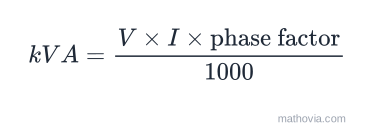
The phase configuration determines the multiplier used in the apparent power calculation. Single-phase systems use a factor of 1. Balanced three-phase systems use the square root of 3, approximately 1.732.
Phase factor = 1 for single-phase
Phase factor = √3 = 1.7320508075688772 for three-phase
With the default selection, the transformer is single-phase:
Transformer type = Single-phase
Phase factor = 1
Step Two: Multiply load current by voltage
First calculate the apparent power in volt-amperes by multiplying the load current by the load voltage.
Apparent power = Load current × Load voltage × Phase factor
Using the default inputs:
Apparent power = 25 A × 240 V × 1
Apparent power = 6,000 VA
Step Three: Convert volt-amperes to kVA
Divide the apparent power in volt-amperes by 1,000 to express the result in kilovolt-amperes.
Minimum transformer size = Apparent power ÷ 1,000
Using the default values:
Minimum transformer size = 6,000 VA ÷ 1,000
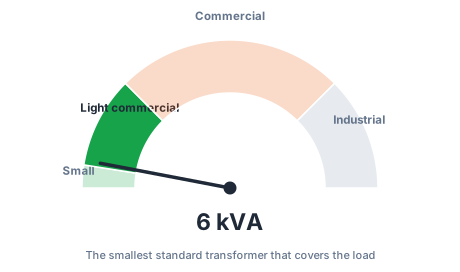
Minimum transformer size = 6 kVA
What your results mean
The result is the minimum kVA the transformer must carry to serve the entered load continuously. With the defaults — 25 A, 240 V, single-phase — that’s 6 kVA.
It’s an apparent-power figure, nothing more. It says nothing about the transformer’s efficiency, its physical size, its impedance, or how it behaves during a fault. And 6 kVA is the floor, not the pick: a transformer loaded to exactly its nameplate runs hot, ages faster, and has no room for the load to grow.
Standard sizes and where the calculated load lands
| Calculated minimum | Next standard single-phase rating |
|---|---|
| up to 3 kVA | 3 kVA |
| 3–5 kVA | 5 kVA |
| 5–7.5 kVA | 7.5 kVA |
| 7.5–10 kVA | 10 kVA |
| 10–15 kVA | 15 kVA |
| 15–25 kVA | 25 kVA |
A 6 kVA calculated load points to a 7.5 kVA transformer, or 10 kVA if the load is continuous or expected to grow.
What to add on top of the bare number
- Continuous-load margin. For loads running three hours or more, common practice keeps the transformer at 80% of rating or below.
- Motor inrush. A motor started across the line pulls locked-rotor current several times its running value; the transformer has to hold voltage through it.
- Harmonics. Variable-frequency drives, LED drivers, and computer supplies distort the current waveform and add heating a plain kVA figure misses. K-rated transformers exist for this.
- Ambient temperature and enclosure. A transformer in a hot, unventilated room is derated.
- Future load. Adding a circuit later is far cheaper if the transformer already has spare capacity.
Common mistakes
- Using the single-phase formula for a three-phase load — a 42% undersize.
- Sizing to the calculated minimum with no margin.
- Summing nameplate currents that never run together, which oversizes and wastes money — use a realistic demand factor.
- Ignoring the secondary voltage — the kVA is the same on both windings, but the currents differ, so check both sides against their conductors.
For the current a transformer’s kVA rating implies, see the kVA to amps calculator. To convert the load to real power, use kVA to kW.