Mathovia

Electrical / Power & Wattage

Kilovolt-Amps (kVA) to Kilowatts (kW) Conversion Calculator

Calculate real power from apparent power.

Real Power
4.000 kW
002.52547.56108kVAkW5 kVA4 kW
Real power is apparent power scaled by the power factor.

Use the stated electrical relationship and enter values in the displayed units.

Source: Formula conventions follow standard electrical engineering relationships. Verify equipment ratings and local code requirements before installation.

Written by
MPhil in Mathematics, Founder of Mathovia
Published

Mathematics verification: Mathematical formulas, calculations, worked examples and solutions are reviewed for accuracy before publication. How we check our work

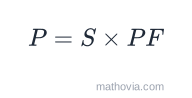
Kilovolt-Amps (kVA) to Kilowatts (kW) Conversion Calculator formula
The Kilovolt-Amps (kVA) to Kilowatts (kW) Conversion formula

Apparent power versus real power

Every AC load pulls two kinds of current. One is in step with the voltage and does the actual work — heating, turning a shaft, lighting a filament. The other lags or leads the voltage and shuttles energy back and forth into magnetic fields and capacitors without consuming any of it. Add them together and you get apparent power, measured in kVA. Keep only the working part and you get real power, measured in kW. The ratio between them is the power factor.

This conversion matters because the two units answer different questions. A generator or UPS is rated in kVA because that’s what its alternator and wiring have to carry. The load you want to run is described in kW because that’s the work it does. To know whether a 5 kVA generator can run a 4 kW load, you have to get both onto the same footing.

The kVA to kW formula

is real power in kW, is apparent power in kVA, and is the power factor — a number from 0 to 1. The three quantities form the sides of the power triangle: apparent power is the hypotenuse, real power is the horizontal leg, and reactive power (kVAR) is the vertical leg, so .

Worked example

The calculator’s defaults are 5 kVA at a power factor of 0.8.

The load consumes 4 kW of real power. The remaining 3 kVAR of reactive power — from — circulates without doing work, but the generator’s alternator and the feeder conductors still have to carry the current that goes with the full 5 kVA.
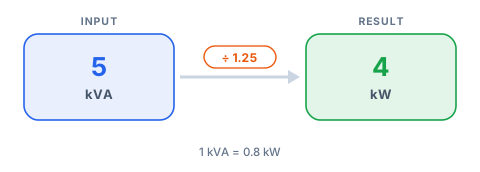
Kilovolt-Amps (kVA) to Kilowatts (kW) Conversion Calculator worked example diagram
A visual read of the worked example above — the same numbers the calculator returns for its default inputs.

How power factor sets the result

Apparent powerPF 1.0PF 0.9PF 0.8PF 0.6
5 kVA5.0 kW4.5 kW4.0 kW3.0 kW
10 kVA10.0 kW9.0 kW8.0 kW6.0 kW
25 kVA25.0 kW22.5 kW20.0 kW15.0 kW

The same generator delivers noticeably less usable power into a poor-power-factor load. This is why a lightly loaded motor — which has a bad power factor — is such an inefficient use of a generator’s capacity.

Reading a dual-rated nameplate

Generators and UPS units often print both figures, for example “5 kVA / 4 kW.” The kW number already assumes a power factor, almost always 0.8. If your actual load runs at a higher power factor you can approach the full 5 kW; at a lower one you’re capped below 4 kW. Always compare your load’s real power factor against that 0.8 assumption before trusting the nameplate kW.

Common mistakes

  • Assuming kW equals kVA. Only true at unity power factor — resistive loads.
  • Using the generic 0.8 for a resistive load (should be 1.0) or for a lightly loaded motor (often 0.5–0.7).
  • Sizing a generator to the kW figure and ignoring kVA. The alternator limit is kVA; a 4 kW load at 0.6 power factor is 6.7 kVA and can overload a “5 kW” generator.

For the reverse, use the kW to kVA calculator. To get the line current from either figure, see kVA to amps.

About the formula: Use the stated electrical relationship and enter values in the displayed units.

Frequently Asked Questions

How does this kVA to kW conversion work?+

Real power equals apparent power times power factor: kW = kVA × PF. Power factor is the share of the apparent power that does actual work, so the multiplication strips out the reactive part that flows back and forth without being consumed.

What is 5 kVA in kW?+

At the default power factor of 0.8, 5 kVA is 4 kW. At a power factor of 1 it would be the full 5 kW; at 0.6 it would be only 3 kW. The kVA figure is fixed by the equipment, and the power factor decides how much of it is usable power.

Why is kW always less than or equal to kVA?+

Power factor can't exceed 1, so multiplying kVA by it never increases the number. The two are equal only for a purely resistive load — heaters, incandescent lighting — where there's no reactive component.

My generator says 5 kVA / 4 kW. Which do I use?+

Both, for different checks. The 4 kW is the real power it can supply at an assumed 0.8 power factor. If your actual load has a higher power factor you get closer to 5 kW; if it's lower, you're limited to less. Compare your load's power factor against the 0.8 assumption.

How do I find my load's real power factor?+

Motor and HVAC nameplates often print it. A power meter or a clamp meter with true-power-factor reading measures it directly. Utility bills with power-factor metering report a monthly average. The 0.8 default here is a stand-in for a typical mixed inductive load.

Does converting kVA to kW change the current draw?+

No. Current is set by kVA and voltage. Converting to kW just tells you how much of that apparent power turns into work; the amps in the conductors stay the same.

Related calculators