
For decades we bought light bulbs by wattage, because for incandescents wattage and brightness went hand in hand. LEDs broke that link. A modern LED can put out the light of an old 100-watt bulb while drawing 9 watts, and two LEDs of the same brightness can differ by a factor of two in power draw depending on how efficient they are. So the right way to size an LED is to start from the light you actually want — measured in lumens — and divide by how efficiently the lamp turns electricity into light.
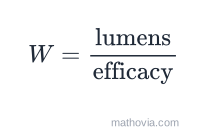
The LED wattage formula
Watts equals the target light output in lumens divided by the luminous efficacy in lumens per watt. The lumen units cancel, leaving watts. Efficacy is the whole story of why LEDs save energy: an incandescent manages about 15 lm/W, a halogen around 20, a CFL 60, and a good LED 100 to 150 or more.
Worked example
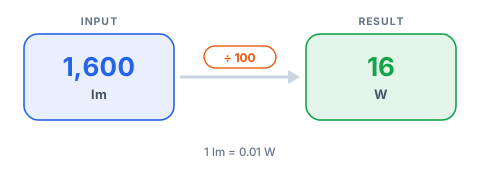
The calculator’s defaults are a target of 1,600 lumens and an LED efficacy of 100 lm/W.
So a 100 lm/W LED needs 16 watts to produce 1,600 lumens — the brightness of a traditional 100-watt incandescent. At a better efficacy of 133 lm/W, the same 1,600 lumens would need only about 12 watts.
Lumens you need, by the bulb you’re replacing
| Old incandescent | Lumens (approx.) | LED watts at 100 lm/W | at 150 lm/W |
|---|---|---|---|
| 25 W | 250 lm | 2.5 W | 1.7 W |
| 40 W | 450 lm | 4.5 W | 3.0 W |
| 60 W | 800 lm | 8 W | 5.3 W |
| 75 W | 1,100 lm | 11 W | 7.3 W |
| 100 W | 1,600 lm | 16 W | 10.7 W |
| 150 W | 2,600 lm | 26 W | 17.3 W |
The lumen column is the number to match. The “equivalent wattage” printed on an LED box is the manufacturer’s estimate of which incandescent it replaces, and it isn’t always consistent between brands.
What the estimate doesn’t cover
The result is the bare lamp’s electrical draw. Several things sit between it and the light in the room:
- Driver losses. The circuit that converts mains AC to the LED’s low-voltage DC is 80–92% efficient, and cheaper drivers do worse.
- Optical losses. A frosted diffuser, a deep can, or a lens absorbs some light.
- Heat. LEDs lose efficiency and lifespan when they run hot, which is why enclosed fixtures need lamps rated for enclosed use.
- Lumen depreciation. An LED slowly dims over its life; “L70” means it drops to 70% output by its rated hours.
Common mistakes
- Entering the “equivalent” incandescent wattage as the lumen target. Use actual lumens.
- Assuming all LEDs are equally efficient. Efficacy ranges roughly 2:1 across products.
- Ignoring beam angle. A spotlight and a floodlight with the same lumens light a room very differently.
- Forgetting color rendering. High-CRI lamps often trade a little efficacy for better color.
Lumens describe light leaving the lamp; lux describes light landing on a surface. For laying out lighting in a whole room, a separate illuminance calculation that accounts for area, mounting height, and wall reflectance is the right tool.