
A battery runtime estimate helps you check whether a battery can support a device, backup system, or portable setup for the required duration. The calculation converts the battery’s amp-hour rating into usable watt-hours, then compares that energy with the load’s power demand. It is an estimate, not a guarantee of real-world performance.
How to Calculate Battery Runtime (step by step)
Step One: Calculate the battery’s rated energy
Multiply battery capacity by battery voltage to estimate the battery’s total energy.
Battery energy = battery capacity × battery voltage
Battery energy = 100 Ah × 12 V = 1,200 Wh
Step Two: Apply the usable depth of discharge
Multiply total battery energy by the depth of discharge expressed as a decimal. The default depth of discharge is 80%, which becomes 0.80.
Usable energy = battery energy × (depth of discharge ÷ 100)
Usable energy = 1,200 Wh × (80 ÷ 100) = 960 Wh
Step Three: Divide usable energy by load power
Divide usable watt-hours by the load’s wattage to find runtime in hours.
Runtime = usable energy ÷ load power
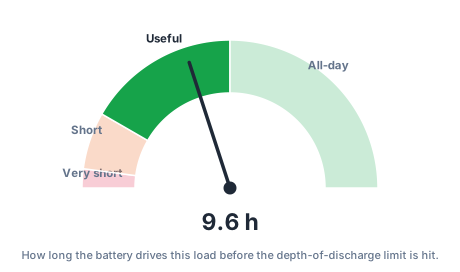
Runtime = 960 Wh ÷ 100 W = 9.6 h
Step Four: Convert hours to days
Divide the runtime in hours by 24 to express the result in days.
Runtime in days = runtime in hours ÷ 24
Runtime in days = 9.6 h ÷ 24 = 0.40 d
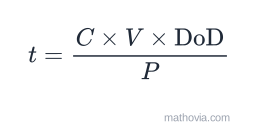
The runtime formula
Worked example
The calculator’s defaults are a 100 Ah, 12 V battery, an 80% depth of discharge, and a 100 W load.
Rated energy:
Usable energy:
Runtime:
That’s the ideal figure. Send that 100 W through an inverter at 90% efficiency and you’d get closer to 8.6 hours of real runtime.
Runtime vs load, for a 100 Ah 12V battery at 80% DoD
| Load | Ideal runtime | With 90% inverter |
|---|---|---|
| 25 W | 38.4 h | 34.6 h |
| 50 W | 19.2 h | 17.3 h |
| 100 W | 9.6 h | 8.6 h |
| 300 W | 3.2 h | 2.9 h |
| 600 W | 1.6 h | 1.4 h |
| 1,000 W | 0.96 h | 0.86 h |
Runtime is inversely proportional to load — halve the watts and you double the hours.
What pulls real runtime below the estimate
- Inverter conversion and idle draw. 85–92% efficient, plus a constant tax of a few watts just to stay on.
- Depth-of-discharge limits. Draining a flooded lead-acid battery to 80% every cycle will wear it out in a year; 50% is the usual limit, which halves the usable energy.
- Temperature. A cold battery delivers less; capacity can drop 20–30% near freezing.
- Age. Every chemistry fades. A battery at 80% state of health has lost a fifth of its capacity.
- Discharge rate. Lead-acid loses usable capacity under heavy load (Peukert’s law); lithium barely notices.
- Surge loads. Motors and compressors draw several times their running watts at startup, which the average-power figure doesn’t capture.
Common mistakes
- Using 100% depth of discharge for lead-acid. Use 50%.
- Ignoring the inverter for AC loads.
- Feeding in rated wattage for a cycling load instead of its average.
- Forgetting voltage — amp-hours must become watt-hours first.
To convert a battery’s rating between units, see the amp-hours to watt-hours calculator and amp-hours to kWh.