Mathovia

Electrical / Power & Wattage

Kilovolt-Amps (kVA) to Amps Conversion Calculator

Calculate current from apparent power, voltage, and system phase.

Current
20.83 A
002.510.42520.837.531.251041.67kVAA5 kVA20.83 A
1 kVA = 4.16667 A

Use the stated electrical relationship and enter values in the displayed units.

Source: Formula conventions follow standard electrical engineering relationships. Verify equipment ratings and local code requirements before installation.

Written by
MPhil in Mathematics, Founder of Mathovia
Published

Mathematics verification: Mathematical formulas, calculations, worked examples and solutions are reviewed for accuracy before publication. How we check our work

Kilovolt-Amps (kVA) to Amps Conversion Calculator formula
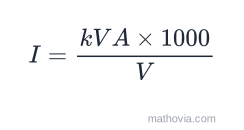
The Kilovolt-Amps (kVA) to Amps Conversion formula

Why this conversion matters

Generators, transformers, UPS units, and service panels are rated in kVA — apparent power. Breakers, conductors, and disconnect switches are rated in amps. To connect a kVA-rated piece of equipment to a real circuit, you have to turn its kVA rating into a current, and that needs the voltage and whether the system is single- or three-phase.

The useful thing about working from kVA rather than kW is that power factor drops out. Apparent power already bundles the reactive current in with the working current, so the amps that flow in the wire depend only on the kVA and the voltage. That’s exactly why transformers carry a kVA rating in the first place: their limiting factor is winding heat, which is set by current, no matter what the power factor of the load turns out to be.

The kVA to amps formula

Single-phase:

Three-phase, using line-to-line voltage:

is the line current in amps, is the apparent power, and is the voltage. The factor of 1,000 converts kVA to VA; the √3 in the three-phase version is there because the three line currents are 120° apart, so the total apparent power isn’t simply three times one line’s volts-times-amps.

Worked example

The calculator’s defaults are 5 kVA on a single-phase 240 V circuit.

Convert to volt-amps:

Divide by the voltage:

So each conductor carries about 20.8 A. On the same 5 kVA at 240 V three-phase, the current per line drops to 5,000 ÷ (1.732 × 240) ≈ 12.0 A, because the load is spread over three wires instead of two.
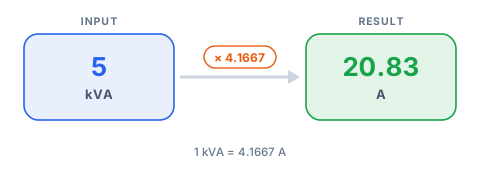
Kilovolt-Amps (kVA) to Amps Conversion Calculator worked example diagram
A visual read of the worked example above — the same numbers the calculator returns for its default inputs.

kVA to amps at common voltages (single-phase)

kVA120 V208 V240 V480 V
18.3 A4.8 A4.2 A2.1 A
541.7 A24.0 A20.8 A10.4 A
1083.3 A48.1 A41.7 A20.8 A
25208 A120 A104 A52.1 A
50417 A240 A208 A104 A

For three-phase, divide any value in the table by 1.732.

What the result does and doesn’t cover

This is the steady, balanced running current. It doesn’t include the inrush a motor or transformer pulls at startup, which can be several times higher for a fraction of a second. It also assumes the three phases are evenly loaded — an unbalanced panel will run more current on one line than this figure suggests. Size conductors and overcurrent protection from the equipment’s nameplate full-load amps and the ampacity tables, using this number as a cross-check.

Common mistakes

  • Forgetting the √3 for three-phase, which overstates the current by about 73%.
  • Using line-to-neutral voltage where line-to-line belongs in the three-phase formula.
  • Applying a power factor. kVA to amps doesn’t use one; power factor only matters when converting to kW or watts.

For the reverse, use the amps to kVA calculator. To find the real power behind the apparent power, see kVA to kW, and for the working current of a kW-rated load, kW to amps.

About the formula: Use the stated electrical relationship and enter values in the displayed units.

Frequently Asked Questions

How many amps is a 5 kVA transformer at 240 volts?+

On a single-phase 240 V circuit, 5 kVA ÷ 240 V = 20.8 A. On a three-phase 240 V circuit the same 5 kVA is 5,000 ÷ (1.732 × 240) ≈ 12.0 A per line, because the load is shared across three conductors.

How does this kVA to amps conversion work?+

Apparent power in volt-amps is voltage times current, so dividing volt-amps by voltage gives current back. For three-phase, divide by √3 times the line-to-line voltage instead, since the three line currents are 120° apart.

Why does three-phase need only one voltage and no phase currents?+

A balanced three-phase load draws equal current in all three lines, so one line-to-line voltage and the total kVA are enough. The result is the current in each line, not a sum of the three.

Can I size a breaker or wire straight from this number?+

No. Start from the equipment's nameplate full-load amps, then apply the ampacity tables, temperature and conduit-fill derating, and the 125% continuous-load margin your code requires. This figure is for cross-checking a nameplate or estimating from a kVA-only spec.

Does the power factor matter for kVA to amps?+

No. kVA is apparent power, which already includes the reactive part, so the current follows from kVA and voltage alone. Power factor only enters when you convert kVA to real power in kW or watts.

What about motor inrush current?+

This gives the steady running current only. A motor or transformer can pull three to eight times this value for a fraction of a second at startup, which is why breakers have a time delay and why generators are often sized well above the running kVA.

Related calculators