
Stoichiometry is the bookkeeping of chemistry: it tells you how much product a given amount of reactant can possibly make, and how much starting material you need to hit a target amount. Balances measure grams, but reactions happen in moles, so every stoichiometry problem is really a three-part trip: grams to moles, moles to moles, moles back to grams. Get that habit right and yield calculations, reagent scale-ups, and lab prep sheets all become mechanical.
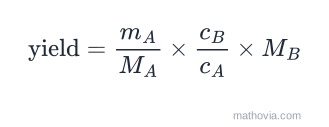
The stoichiometry chain
Mass of the known reactant
How to Calculate Stoichiometry (step by step)
Step One: Convert the known mass to moles
Divide the mass of your known substance by its molar mass. This is the only step that touches the balance reading.
moles of reactant = mass in grams ÷ molar mass (g/mol)
moles of H₂ = 10 ÷ 2.016 = 4.9603 mol
Step Two: Apply the mole ratio from the balanced equation
The coefficients in the balanced equation are a mole ratio, not a mass ratio. Multiply by the product coefficient over the reactant coefficient.
moles of product = moles of reactant × (product coefficient ÷ reactant coefficient)
2 H₂ + O₂ → 2 H₂O
moles of H₂O = 4.9603 × (2 ÷ 2) = 4.9603 mol
Step Three: Convert product moles back to mass
Multiply the moles of product by the product’s molar mass. This result is the theoretical yield: the absolute maximum a perfect reaction could give you.
theoretical yield = moles of product × molar mass of product (g/mol)
mass of H₂O = 4.9603 × 18.015 = 89.36 g
Step Four: Compare with what you actually collected
Real reactions lose material to side reactions, incomplete conversion, and transfer losses. Percent yield quantifies that gap.
percent yield = (actual yield ÷ theoretical yield) × 100
percent yield = (75 ÷ 89.36) × 100 = 83.93%
What your results mean
Moles of reactant (4.9603 mol) is your known quantity translated into particle counts. Moles of product (4.9603 mol) is that count rescaled by the equation; here the ratio is 2:2, so the numbers match, but with something like N₂ + 3 H₂ → 2 NH₃ the ratio would change them noticeably.
Theoretical yield (89.36 g) is your ceiling. Notice that 10 g of hydrogen becomes roughly 89 g of water: mass is conserved because oxygen joins in, which is exactly why you can never reason about yields using grams alone.
Percent yield (83.93%) is the practical verdict. For routine inorganic reactions 90% and up is expected, 70-90% is normal for multi-step organic work, and anything under 50% usually points to a procedural problem rather than chemistry. Molecules of product (2.99 × 10²⁴) is the same amount expressed as individual particles via the Avogadro constant, useful for gas-phase and spectroscopy work.
Common mistakes to avoid
Using mass ratios instead of mole ratios is the number one error; coefficients never multiply grams directly. Second is forgetting subscripts when computing molar mass: H₂ is 2.016 g/mol, not 1.008. Third is assuming your known reactant is the limiting one when both reactants are measured out; if you weighed out two reactants, check both.
Handy molar masses
| Substance | Molar mass (g/mol) |
|---|---|
| H₂ | 2.016 |
| O₂ | 31.998 |
| H₂O | 18.015 |
| CO₂ | 44.009 |
| NaCl | 58.44 |
| NH₃ | 17.031 |
To scale a reaction in reverse, put your target product in the reactant slots and the starting material in the product slots: the same arithmetic then tells you how many grams of reagent to weigh out.
Where stoichiometry is used
- Lab yields and reports — computing theoretical yield and then percent yield after a synthesis.
- Reagent scale-up — working out how much of each reactant to order for a target batch of product.
- Titration — moles of analyte from moles of titrant through the reaction ratio.
- Combustion and emissions — CO₂ produced per kg of fuel burned.
- Industrial process design — feed rates and product output tied together by the balanced equation.
Common mistakes
- Using mass ratios instead of mole ratios. Coefficients never multiply grams directly.
- Forgetting subscripts in a molar mass — H₂ is 2.016 g/mol, not 1.008.
- Assuming the weighed reactant is limiting when two reactants were measured out — check both.
- Inverting the coefficient ratio (reactant over product instead of product over reactant).
- Rounding moles early, which drifts through the later steps.
For the balanced equation the coefficients come from, use the chemical equation balancer. For just the yield comparison, see the percent yield calculator; for a compound picker that supplies molar masses, grams to moles.