
Balancing a chemical equation means putting a coefficient in front of each formula so that every element has the same number of atoms on both sides. It is the working form of the law of conservation of mass: a reaction rearranges atoms into new combinations, but it never creates or destroys them. This calculator takes a typed reaction, reads the atom counts out of each formula, and solves for the coefficients directly, rather than restricting you to one reaction type.
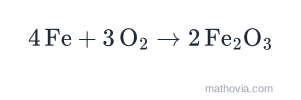
How balancing works, as algebra
Assign an unknown coefficient to each compound. For each element, write an equation setting its total on the left equal to its total on the right. For Fe + O₂ → Fe₂O₃ with coefficients
Pick
How to Balance a Chemical Equation (step by step)
Step One: Write formulas and separate the sides
Enter each substance with its correct chemical formula, put plus signs between substances on the same side, and use one arrow between reactants and products.
unbalanced equation = Fe + O2 -> Fe2O3
input = Fe + O2 -> Fe2O3
Step Two: Count each element in every compound
The parser reads subscripts and parentheses as atom counts. A missing subscript means one atom, while a subscript after parentheses multiplies the entire group.
Fe = 1 Fe
O2 = 2 O
Fe2O3 = 2 Fe + 3 O
element rows = Fe, O
compound columns = Fe, O2, Fe2O3
Step Three: Solve the conservation equations
The calculator finds coefficients that make each element total match on both sides. It uses exact fractions internally, so a temporary fractional ratio does not create rounding errors.
iron balance: Fe coefficient = 2 x Fe2O3 coefficient
oxygen balance: 2 x O2 coefficient = 3 x Fe2O3 coefficient
coefficient ratio = 4 : 3 : 2
Step Four: Reduce the coefficients to whole numbers
Multiply through by the smallest common factor, then divide out any common divisor. Coefficients of one are omitted in the displayed equation.
balanced equation = 4 Fe + 3 O2 -> 2 Fe2O3
coefficient pattern = 4 : 3 -> 2
atom check = Fe: 4 = 4, O: 6 = 6
What your results mean
The balanced equation is the reaction written with the smallest whole-number mole ratio. The default example says that 4 moles of iron react with 3 moles of oxygen to form 2 moles of iron(III) oxide. Those coefficients can be carried into a stoichiometry calculator when you need masses, limiting reactants, or theoretical yield.
The coefficient pattern shows the numbers in input order, first for reactants and then for products. The atom check is a quick audit of the result: every listed element should have the same total on each side. For mass-based work, calculate each compound’s formula weight with a molar mass calculator before converting the mole ratio into grams.
Input limits and common mistakes
Use valid formulas and do not change subscripts to force a balance. The parser supports normal element symbols, nested parentheses or brackets, hydrate notation with a middle dot, and common state labels. It does not interpret reaction conditions, catalysts, electron-transfer notation, or unusual charge notation as separate balancing entities, so verify redox reactions and ionic equations carefully.
More balanced examples
| Unbalanced | Balanced |
|---|---|
| H₂ + O₂ → H₂O | 2 H₂ + O₂ → 2 H₂O |
| CH₄ + O₂ → CO₂ + H₂O | CH₄ + 2 O₂ → CO₂ + 2 H₂O |
| C₃H₈ + O₂ → CO₂ + H₂O | C₃H₈ + 5 O₂ → 3 CO₂ + 4 H₂O |
| Al + HCl → AlCl₃ + H₂ | 2 Al + 6 HCl → 2 AlCl₃ + 3 H₂ |
| KMnO₄ + HCl → KCl + MnCl₂ + H₂O + Cl₂ | 2 KMnO₄ + 16 HCl → 2 KCl + 2 MnCl₂ + 8 H₂O + 5 Cl₂ |
Where balancing fits in
- Before any stoichiometry — the coefficients are the mole ratio every mass calculation depends on.
- Combustion analysis — balancing a hydrocarbon burn gives the oxygen demand and CO₂/H₂O output.
- Lab prep — knowing the ratio of reagents to combine.
- Teaching and homework, where the balancing procedure itself is the exercise.
Common mistakes
- Changing a subscript to balance. That makes a different substance; only coefficients may change.
- Leaving a polyatomic ion split up when it stays intact through the reaction — balance it as a unit.
- Stopping at a fractional coefficient instead of scaling to whole numbers.
- Forgetting to re-check a hydrate’s water molecules on both sides.
Carry the balanced coefficients into the stoichiometry calculator for masses and yields, and use the molar mass calculator for each compound’s formula weight.