
The best case a reaction can do
Theoretical yield answers a hypothetical: if every molecule of the limiting reagent reacted, none went down a side path, and not a milligram was lost in the flask or the filter, how much product would you have? It’s not a prediction of what you’ll get — that’s always less — but the benchmark that makes the actual result meaningful. A 4 g product is impressive if theory allowed 4.2 g and disappointing if it allowed 12 g.
The calculation is a short chain of unit conversions:
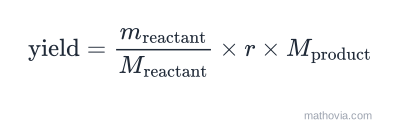
The first and last arrows use molar masses; the middle one uses the mole ratio from the balanced equation.
The theoretical yield formula
Worked example
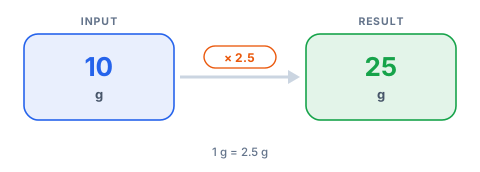
The calculator’s defaults are 10 g of a limiting reagent with molar mass 40 g/mol, a product molar mass of 100 g/mol, and a 1:1 mole ratio.
Moles of reactant:
Moles of product (ratio 1):
Mass of product:
How the mole ratio changes the result
Same 10 g reactant (40 g/mol) and 100 g/mol product, different balanced-equation ratios:
| Balanced relationship | Mole ratio (r) | Theoretical yield |
|---|---|---|
| 1 reactant → 1 product | 1.0 | 25.0 g |
| 2 reactant → 1 product | 0.5 | 12.5 g |
| 1 reactant → 2 product | 2.0 | 50.0 g |
| 2 reactant → 3 product | 1.5 | 37.5 g |
Getting this ratio wrong is the most common error in the whole calculation.
Where theoretical yield is used
- Before a reaction, to estimate how much product to expect and whether it’s worth the effort.
- After a reaction, as the denominator in percent yield.
- Scale-up planning, to work out how much limiting reagent is needed for a target amount of product.
- Comparing routes — two syntheses to the same target, judged partly on their theoretical (and then actual) yields.
Common mistakes
- Using an excess reagent instead of the limiting one — always identify the limiting reagent first.
- Inverting the mole ratio (reactant:product instead of product:reactant).
- Swapping the two molar masses.
- Forgetting to balance the equation before reading coefficients off it.
Feed the result into the percent yield calculator once you have an actual mass. For the full multi-reactant path, see the stoichiometry calculator, and to compute a molar mass, the molar mass calculator.
Finding the limiting reagent: a worked case
For ammonia synthesis,
- Moles of N₂:
mol. - Moles of H₂:
mol. - Reacting all the N₂ would need
mol of H₂. There are 4.46 mol, so H₂ is in excess and N₂ is limiting.
Now run the calculator’s chain on the limiting reagent, with a mole ratio of 2 (two NH₃ per N₂):
As a check, running the same chain on H₂ gives
Theoretical yield in moles
Stop one step early. In the example above, the theoretical yield is