
Counting the uncountable
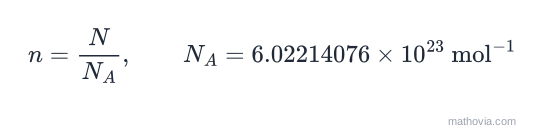
You cannot count atoms one at a time — there are too many of them in any real sample, and they are too small to see. So chemistry counts them in bulk, using the mole: a package of exactly 6.02214076 × 10²³ particles, the same way “a dozen” packages twelve. Converting a raw particle count to moles, or moles back to a particle count, is division or multiplication by that one number, Avogadro’s number.
The calculator runs both directions. Feed it a count as small as 100 atoms and it returns a minuscule fraction of a mole — which is correct. A hundred atoms is far below anything a balance could register.
The atoms to moles formula
Worked example
The calculator’s default is 100 atoms.
And the reverse default, 1 mole:
A sense of scale
| Particle count | Moles | Roughly |
|---|---|---|
| 100 | 1.66 × 10⁻²² | far too little to weigh |
| 6.022 × 10¹⁸ | 1.0 × 10⁻⁵ | 10 µmol — a trace |
| 3.011 × 10²³ | 0.5 | half a mole |
| 6.022 × 10²³ | 1.0 | one mole |
| 1.807 × 10²⁴ | 3.0 | three moles |
Where this conversion shows up
- Nuclear decay. A decay calculation gives a number of atoms remaining; converting to moles (then grams) makes it a weighable quantity.
- Nanoscience. At the nanoscale you sometimes genuinely deal with a countable number of atoms in a cluster or a quantum dot.
- Textbook stoichiometry. Problems that hand you “how many molecules of…” and ask for mass or volume route through this step.
- Spectroscopy and detectors. Photon and particle counts convert to molar quantities the same way.
Common mistakes
- Multiplying when you should divide (or vice versa). Atoms → moles is division by
; moles → atoms is multiplication. - Confusing atoms with molecules. One mole of O₂ contains 6.022 × 10²³ molecules but 1.204 × 10²⁴ atoms.
- Dropping the exponent in scientific notation partway through.
To continue from moles to a mass, use the mole calculator with the substance’s molar mass, or grams to moles for a built-in compound list.
From atoms all the way to grams
Moles are usually a stepping stone to mass. Convert atoms to moles, then multiply by the molar mass. For
So a 6-gram pinch of graphite holds about 300 thousand billion billion atoms.
Counting atoms inside molecules
When the question is about molecules but asks for atoms, multiply by the number of atoms in one molecule. Two moles of water:
Each H₂O has three atoms (two hydrogen, one oxygen), so the atom count is three times the molecule count. For hydrogen atoms alone, multiply by 2 instead.
Dividing in scientific notation by hand
Divide the leading numbers, then subtract the exponents. For
The last step shifts the decimal so the leading number sits between 1 and 10.