
What molar mass is
Molar mass is the weight of one mole of a substance — one Avogadro’s number of its molecules or formula units — expressed in grams per mole. It’s a fixed property that comes straight from the chemical formula: add up the atomic mass of every atom, and that sum is the molar mass. Water is two hydrogens (1.008 each) plus one oxygen (15.999), so 18.015 g/mol.
That single number is the exchange rate between the two ways chemistry measures matter: grams on a balance and moles in an equation. It also works as an identification tool. If you can weigh a sample and independently count its moles — by titrating it, by measuring how much it lowers a solvent’s freezing point, or by collecting it as a gas — then dividing mass by moles hands you the molar mass, and the molar mass narrows down what the substance can be.
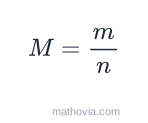
The molar mass formula
Worked example
The calculator’s defaults are a 180.16 g sample containing exactly 1 mole.
That value matches glucose, C₆H₁₂O₆. Check it from the formula:
The two routes agree, which is how you’d confirm an unknown really is glucose.
Molar mass of common compounds
| Compound | Formula | Molar mass (g/mol) |
|---|---|---|
| Water | H₂O | 18.015 |
| Sodium chloride | NaCl | 58.44 |
| Sodium hydroxide | NaOH | 40.00 |
| Sulfuric acid | H₂SO₄ | 98.08 |
| Calcium carbonate | CaCO₃ | 100.09 |
| Glucose | C₆H₁₂O₆ | 180.16 |
| Sucrose | C₁₂H₂₂O₁₁ | 342.30 |
| Copper(II) sulfate pentahydrate | CuSO₄·5H₂O | 249.69 |
Where molar mass is needed
- Every gram–mole conversion, which is the first step of most stoichiometry.
- Solution prep — turning a target molarity and volume into grams to weigh.
- Identifying unknowns in analytical chemistry from mass-and-moles data.
- Checking a synthesis produced the compound you intended, not a byproduct with a different formula weight.
Common mistakes
- Skipping parentheses multipliers. Al₂(SO₄)₃ has 3 sulfurs and 12 oxygens.
- Ignoring waters of hydration. The hydrate weighs more than the anhydrous salt.
- Using atomic mass for a diatomic element — N₂ is 28.014, not 14.007.
- Over-rounding atomic masses before summing.
To go from molar mass to an amount, use the mole calculator or grams to moles. For concentration, see the molarity calculator.
A formula with parentheses
Multiply everything inside the brackets by the subscript outside. Calcium hydroxide, Ca(OH)₂, has one calcium and two hydroxide groups:
A hydrate
The dot in a hydrate’s formula means “plus”. Copper(II) sulfate pentahydrate, CuSO₄·5H₂O:
Water makes up
Molar mass of a gas from the ideal gas law
For a gas, you can find the moles from pressure, volume and temperature, then divide the mass by them. Rearranged,
That’s very close to argon’s 39.95 g/mol, so argon is the likely gas.