
Why molality exists alongside molarity
Molarity is moles per litre of solution — convenient, because you can dispense a volume with a pipette. But a litre isn’t a fixed amount of stuff. Warm a solution and it expands; its molarity drops even though nothing was added or removed. Molality sidesteps that by measuring against the mass of solvent instead. A kilogram of water is a kilogram of water at any temperature, so molality never drifts.
That stability is why the equations for colligative properties — how much a dissolved substance raises a boiling point or lowers a freezing point — are all written in molality. It’s also why antifreeze and road-salt calculations use it.
The trap is the denominator. Molality is per kilogram of solvent — the dissolving liquid alone — not per kilogram of the whole solution.
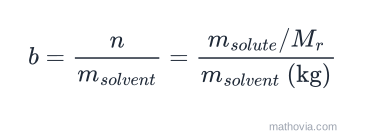
The molality formula
Worked example
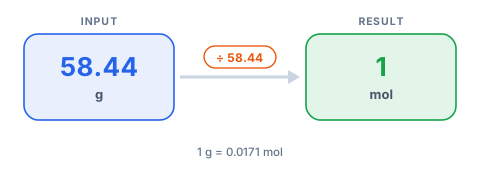
The calculator’s defaults are 58.44 g of NaCl (molar mass 58.44 g/mol) in 1,000 g of water.
Moles of solute:
Solvent mass in kilograms: 1,000 ÷ 1,000 = 1.000 kg. Molality:
A 1 molal NaCl solution.
Molality in colligative-property work
For freezing-point depression,
| Molality (NaCl) | Freezing point depression | Approx. freezing point |
|---|---|---|
| 0.5 mol/kg | 1.86 °C | −1.86 °C |
| 1.0 mol/kg | 3.72 °C | −3.72 °C |
| 2.0 mol/kg | 7.44 °C | −7.44 °C |
| 3.0 mol/kg | 11.16 °C | −11.16 °C |
Where molality is used
- Freezing-point depression and boiling-point elevation calculations.
- Osmotic pressure and other colligative properties.
- Cryoscopy to determine an unknown’s molar mass from how much it depresses a freezing point.
- Any solution work across a temperature range, where a volume-based unit would drift.
Common mistakes
- Using solution mass instead of solvent mass in the denominator.
- Forgetting the van ‘t Hoff factor for salts that dissociate — NaCl gives 2 particles, CaCl₂ gives 3.
- Treating molality and molarity as equal at high concentration or in non-aqueous solvents.
For the volume-based unit, see the molarity calculator. For the mixture-ratio unit used in gas and vapour work, the mole fraction calculator.
Molality from a percent-by-mass solution
Labels often give a mass percent. Assume 100 g of solution, then split it into solute and solvent. A 10% NaCl solution has 10 g of salt and 90 g of water:
The solvent mass is 90 g, not 100 g. Using the full 100 g would give 1.71 mol/kg, about 10% too low.
Converting molarity to molality
You need the solution’s density. For a 1.00 M NaCl solution with a density of about 1.04 g/mL, take one litre:
- Solution mass:
g. - Solute mass:
g. - Solvent mass:
g, or 0.9816 kg.
For dilute water solutions the two units are close. They drift apart as the concentration rises or the solvent’s density moves away from 1.
Boiling-point elevation
The boiling-point version of the colligative formula uses water’s
So the solution boils at about 101.0 °C at sea level. That’s why salting pasta water barely changes its boiling point: a typical pinch gives a molality far below 1.