
Volume as a stand-in for a mole count
Gases have a property that makes them unusually easy to work with: at a fixed temperature and pressure, a mole of any ideal gas takes up the same volume, no matter what the gas is. This is Avogadro’s law, and it means you can measure moles of gas with a graduated cylinder or a gas syringe instead of a balance. The number that ties volume to moles is the molar volume — 22.414 L per mole at 0°C and 1 atm, the definition of STP most textbooks use.
The one thing you must nail down is the conditions. Molar volume depends on temperature and pressure, so a volume measured on a warm day corresponds to fewer moles than the same volume at STP.
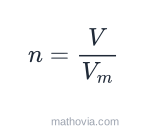
The liters to moles formula
with
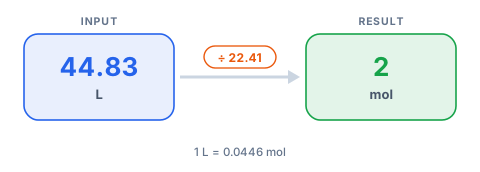
Worked example
The calculator’s defaults are 44.828 L at the STP molar volume of 22.414 L/mol.
Two moles — and it would be two moles whether the gas were hydrogen, oxygen, or carbon dioxide. As a molecule count that’s
Molar volume at different conditions
| Conditions | Molar volume (L/mol) | 44.828 L is |
|---|---|---|
| 0°C, 1 atm (STP) | 22.414 | 2.000 mol |
| 0°C, 1 bar | 22.711 | 1.974 mol |
| 25°C, 1 atm | 24.465 | 1.833 mol |
| 20°C, 1 atm | 24.055 | 1.864 mol |
| 100°C, 1 atm | 30.619 | 1.464 mol |
The same 44.8 L holds noticeably fewer moles when it’s warm, because the gas has expanded.
Where gas-volume-to-moles is used
- Gas-collection experiments. Measure the volume of hydrogen from a metal–acid reaction, convert to moles, back-calculate the metal.
- Combustion analysis. CO₂ and H₂O volumes from burning a sample give moles of carbon and hydrogen.
- Stoichiometry with a gaseous reactant or product, where the balanced equation’s mole ratio predicts a volume.
- Respirometry and gas exchange in biology and environmental work.
Moles to liters: going the other way
The same molar volume converts in reverse. Multiply moles by the molar volume instead of dividing:
At STP, 0.5 mol of any ideal gas fills
Liters of a solution to moles
If the liters are a solution rather than a gas, molar volume doesn’t apply. Use the solution’s concentration (its molarity, in mol/L) instead:
For 0.250 L of a 2.0 M salt solution,
Common mistakes
- Using 22.4 L/mol when the gas is at room temperature, not 0°C — that overstates the moles by about 8%.
- Forgetting to correct for water vapour when a gas is collected over water; subtract the vapour pressure first.
- Applying it to a liquid or a dissolved gas. Molar volume is for the gas phase only.
To compute the exact molar volume for your conditions, use the ideal gas law calculator. For mass-based amounts, see the mole calculator.