
Oxidation numbers are a way of pretending every bond is fully ionic so you can keep score of electrons. Assign the shared electrons in each bond to whichever atom pulls harder, add up the imaginary charge on each atom, and you have a tool that tells you at a glance which species got oxidized, which got reduced, and whether a formula you’ve written is even possible. This calculator works from charge balance: you give it the overall charge, one known oxidation state, and the atom counts, and it solves for the unknown.
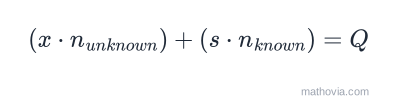
The charge-balance equation
The oxidation numbers of every atom in a species, each multiplied by how many of that atom there are, must add up to the species’ overall charge:
Solving for the unknown oxidation number
where
How to Calculate Oxidation Number (step by step)
Step One: Set up the charge-balance equation
The algebraic sum of every element’s oxidation-number contribution must equal the overall charge of the compound or ion.
Overall charge = (unknown oxidation number × unknown atom count) + (known oxidation state × known atom count)
For the default example, the unknown element appears once, oxygen has an oxidation state of -2, and the ion has an overall charge of -2.
-2 = (unknown oxidation number × 1) + (-2 × 4)
Step Two: Calculate the known contribution
Multiply the known element’s oxidation state by the number of atoms of that element. This gives the known portion of the total charge.
Known contribution = known oxidation state × known atom count
Using the default values:
Known contribution = -2 × 4 = -8
Step Three: Isolate the unknown oxidation number
Subtract the known contribution from the overall charge, then divide by the number of atoms whose oxidation number is unknown.
Unknown oxidation number = (overall charge - known contribution) ÷ unknown atom count
With the default values:
Unknown oxidation number = (-2 - (-8)) ÷ 1 = 6
The result is positive six, written as +6. This is the oxidation number of sulfur in sulfate, SO₄²⁻. If you need the compound’s formula mass before doing charge-balance work, use a molar mass calculator. For reaction accounting, a chemical equation balancer can help ensure the atom counts are correct.
What your results mean
A positive oxidation number means the atom is assigned fewer electrons than its neutral-atom reference state, while a negative value indicates greater assigned electron ownership. An oxidation number of zero commonly appears for an element in its uncombined form.
The result depends entirely on accurate atom counts and known oxidation states. Common rules include assigning oxygen an oxidation state of -2 in most compounds, hydrogen +1 when bonded to nonmetals, and the total oxidation-number sum equal to zero in a neutral compound. Exceptions exist, so use the result as a charge-balance calculation rather than a replacement for chemical context.
Worked examples for common species
| Species | Known state | Setup | Unknown |
|---|---|---|---|
| SO₄²⁻ | O = −2 (×4) | −2 = x + (−8) | S = +6 |
| NO₃⁻ | O = −2 (×3) | −1 = x + (−6) | N = +5 |
| MnO₄⁻ | O = −2 (×4) | −1 = x + (−8) | Mn = +7 |
| Cr₂O₇²⁻ | O = −2 (×7) | −2 = 2x + (−14) | Cr = +6 |
| NH₄⁺ | H = +1 (×4) | +1 = x + (+4) | N = −3 |
| H₂O₂ | H = +1 (×2) | 0 = 2·(O) + (+2) | O = −1 (peroxide) |
Where oxidation numbers are used
- Balancing redox reactions by the oxidation-number-change or half-reaction method.
- Naming compounds — the Roman numeral in “iron(III) chloride” is the oxidation state.
- Identifying oxidizing and reducing agents in a reaction.
- Checking a proposed formula for charge consistency before trusting it.
Common mistakes
- Applying O = −2 to a peroxide (it’s −1) or to OF₂ (it’s +2).
- Assuming H is always +1 — in metal hydrides like NaH it’s −1.
- Confusing oxidation number with formal charge or with actual ionic charge — they can differ.
- Miscounting atoms, especially oxygens in polyatomic ions.
For the formula weight of the species you’re analysing, use the molar mass calculator; to verify the atom counts in a reaction, the chemical equation balancer.