
A buffer holds a solution’s pH nearly steady even when acid or base is added — the property that makes blood, seawater, and countless lab and industrial processes possible. It works by keeping a weak acid and its conjugate base present together: added hydrogen ions react with the base, added hydroxide reacts with the acid, and the pH barely moves. This calculator estimates a buffer’s pH from the acid’s strength (its pKa) and the concentrations of the two forms, using the Henderson-Hasselbalch equation.
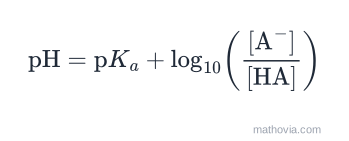
The Henderson-Hasselbalch equation
Worked example
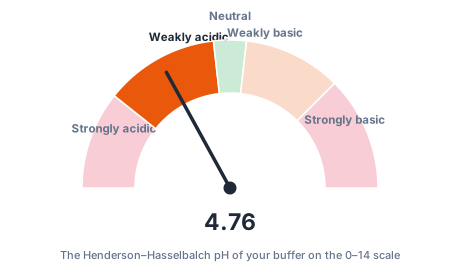
The calculator’s defaults are pKa 4.76 (acetic acid), with the weak acid and conjugate base both at 0.100 M.
Base-to-acid ratio:
Buffer pH:
Total buffer concentration:
Because the two forms are equal, the log term is zero and the pH sits exactly at the pKa — the point of maximum buffering strength.
How the ratio sets the pH
| Base : acid ratio | log₁₀(ratio) | pH (pKa 4.76) |
|---|---|---|
| 1 : 10 | −1.00 | 3.76 |
| 1 : 3 | −0.48 | 4.28 |
| 1 : 1 | 0.00 | 4.76 |
| 3 : 1 | +0.48 | 5.24 |
| 10 : 1 | +1.00 | 5.76 |
A buffer is effective roughly within ±1 pH unit of the pKa — the range where neither form drops below about a tenth of the other. Push past that and adding a little acid or base swamps the minority component and the pH lurches.
What your results mean
The buffer pH estimates the hydrogen-ion environment of the solution. A pH near the weak acid’s pKa usually indicates effective buffering because both forms are present in useful amounts. Buffers generally work best within about one pH unit above or below the pKa.
The base-to-acid ratio shows which component is more abundant. A value above 1 means the conjugate base dominates and the pH is above the pKa. A value below 1 means the weak acid dominates and the pH is below the pKa.
The total buffer concentration is useful when preparing solutions or comparing buffer capacity. Two buffers can have the same pH but different total concentrations: the more concentrated one typically neutralizes more added acid or base before its pH changes substantially.
Important assumptions
Use concentrations in the same units, such as molarity for both inputs. The equation assumes the acid and conjugate base are the relevant buffering pair and that activity effects are small. At high concentrations, extreme pH values, or substantial ionic strength, measured pH can differ from this ideal estimate. For preparation work, account separately for dilution, purity, hydrates, and the actual volume of solvent.
This calculator estimates equilibrium pH; it does not determine the amount of strong acid or strong base needed to adjust an existing solution after mixing.
Common buffer systems
| Buffer pair | pKa | Useful pH range |
|---|---|---|
| Acetic acid / acetate | 4.76 | 3.8 – 5.8 |
| Carbonic acid / bicarbonate | 6.35 | 5.4 – 7.4 |
| Dihydrogen phosphate / hydrogen phosphate | 7.21 | 6.2 – 8.2 |
| TRIS-H⁺ / TRIS | 8.07 | 7.1 – 9.1 |
| Ammonium / ammonia | 9.25 | 8.3 – 10.3 |
| Bicarbonate / carbonate | 10.33 | 9.3 – 11.3 |
Where buffer calculations are used
- Biochemistry and cell biology — keeping enzyme assays, protein preps, and cultures at a fixed physiological pH.
- Analytical chemistry — mobile-phase pH in HPLC, and calibration of pH meters.
- Pharmaceutical formulation — holding an injectable or eyedrop at a pH the body tolerates.
- Fermentation and water treatment — resisting the acid that microbial activity produces.
Common mistakes
- Choosing an acid whose pKa is far from the target pH, leaving almost no capacity.
- Ignoring temperature. TRIS in particular shifts about −0.03 pH units per °C; a buffer set at 25°C runs higher in a cold room.
- Forgetting ionic-strength effects at high concentration, where measured pH drifts from the ideal equation.
- Using the equation to find how much strong acid to add — that’s a titration calculation, not Henderson-Hasselbalch.
To convert the concentrations here into grams to weigh out, use the molarity calculator. For the underlying pH-to-[H⁺] relationship, see the pH calculator.