
Electron configuration is the map of where an atom keeps its electrons — which shells and which subshells (orbitals) they occupy. Almost every chemical property an element has traces back to this arrangement: why sodium is reactive and neon inert, why iron forms coloured compounds, why the periodic table has the block structure it does. Select an element and the calculator returns its ground-state configuration in the compact noble-gas shorthand chemists actually use.
The rules that build a configuration
Three principles fill the orbitals in order:
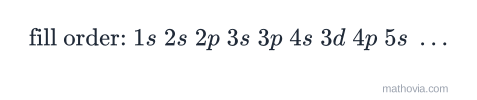
- Aufbau principle — electrons enter the lowest-energy orbital available first. The order is 1s, 2s, 2p, 3s, 3p, 4s, 3d, 4p, 5s, 4d, and so on. Note 4s fills before 3d.
- Pauli exclusion principle — each orbital holds at most two electrons, with opposite spins. So s holds 2, p holds 6, d holds 10, f holds 14.
- Hund’s rule — within a subshell, electrons occupy separate orbitals singly before pairing up.
The number of electrons to place equals the atomic number
How to Calculate Electron Configuration (step by step)
Step One: Identify the electron count
For a neutral atom, the atomic number is equal to the number of electrons. The selected element supplies that number directly.
Electrons in a neutral atom = atomic number
For chlorine, the selected atomic number is seventeen.
Electrons = 17
Step Two: Fill orbitals in energy order
Electrons occupy lower-energy orbitals before higher-energy orbitals. The usual sequence begins with 1s, 2s, 2p, 3s, 3p, 4s, and 3d. Each orbital type has a maximum capacity: s holds two electrons, p holds six, and d holds ten.
Fill orbitals from lower energy to higher energy
For chlorine, the first ten electrons are represented by the neon core, then the remaining electrons enter the third shell.
[Ne] + 3s² + 3p⁵
Step Three: Write noble-gas shorthand
Replace the completed inner configuration with the symbol of the preceding noble gas. This keeps the notation readable while preserving the full electron count.
Electron configuration = noble-gas core + remaining occupied orbitals
The calculator’s default example is chlorine.
Chlorine = [Ne] 3s² 3p⁵
What your results mean
The bracketed symbol represents a stable inner electron configuration. The orbitals written after it describe the outer electrons, which are especially important for chemical reactions. Chlorine’s five electrons in the 3p subshell leave it one electron short of the argon arrangement, helping explain why chlorine commonly forms a one-electron anion.
The notation also reveals the element’s position in the periodic table. A configuration ending in p identifies a p-block element, while a configuration containing d electrons identifies a transition element. For a broader reference, compare the result with the science calculator collection and use a molar mass calculator when connecting electron structure to chemical formulas.
This tool reports neutral-atom ground states through krypton. Excited states, transition-metal ions, and heavier atoms can require additional rules, especially when electrons are removed from the 4s subshell before the 3d subshell.
Configurations across a period
| Element | Z | Configuration | Block / group behaviour |
|---|---|---|---|
| Sodium (Na) | 11 | [Ne] 3s¹ | loses 1 electron → Na⁺ |
| Magnesium (Mg) | 12 | [Ne] 3s² | loses 2 electrons → Mg²⁺ |
| Aluminium (Al) | 13 | [Ne] 3s² 3p¹ | loses 3 electrons → Al³⁺ |
| Silicon (Si) | 14 | [Ne] 3s² 3p² | shares 4 electrons |
| Phosphorus (P) | 15 | [Ne] 3s² 3p³ | gains 3 → P³⁻, or shares |
| Sulfur (S) | 16 | [Ne] 3s² 3p⁴ | gains 2 → S²⁻ |
| Chlorine (Cl) | 17 | [Ne] 3s² 3p⁵ | gains 1 → Cl⁻ |
| Argon (Ar) | 18 | [Ne] 3s² 3p⁶ | full shell, inert |
Reading left to right, the valence shell fills one electron at a time, and the tendency shifts from losing electrons (metals) to gaining them (non-metals) to neither (noble gas).
Where electron configuration is used
- Predicting ion charge — the configuration shows how many electrons an atom will shed or take on to reach a noble-gas arrangement.
- Explaining periodic trends — atomic radius, ionization energy, and electronegativity all follow from how tightly the outer electrons are held.
- Bonding and Lewis structures — the valence electron count comes straight from the configuration.
- Spectroscopy and colour — transition-metal d-electron arrangements determine which wavelengths a compound absorbs.
Common mistakes
- Filling 3d before 4s. The 4s orbital is lower in energy for neutral atoms up to the transition series.
- Forgetting the Cr and Cu exceptions.
- Removing 3d electrons before 4s when making a cation — for transition-metal ions, 4s electrons leave first.
- Miscounting subshell capacity — p is 6, not 8; d is 10.
To connect an element’s structure to a chemical formula’s mass, use the molar mass calculator, and to assign charges in a compound, the oxidation number calculator.