
Enthalpy is the bookkeeping quantity chemists use for energy at constant pressure — the condition almost every open-flask reaction and everyday heating process actually runs at. It bundles together two things: the change in a system’s internal energy, and the work the system does (or has done on it) as it expands or contracts against the surrounding pressure. This calculator combines those into a total enthalpy change and, dividing by the amount of substance, a molar enthalpy change.
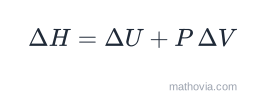
The enthalpy change formula
Worked example
The calculator’s defaults are
Pressure-volume work:
Total enthalpy change:
Molar enthalpy change:
The positive sign means the process is endothermic — it absorbs energy overall. The expansion (
Reading the signs
| Quantity | Positive means | Negative means |
|---|---|---|
| ΔH | endothermic (heat absorbed) | exothermic (heat released) |
| ΔU | internal energy rose | internal energy fell |
| ΔV | system expanded | system compressed |
| PΔV | work done by the system | work done on the system |
Where enthalpy calculations are used
- Reaction thermochemistry — combining ΔU from a bomb calorimeter with a PΔV term to report ΔH.
- Comparing reactions on a per-mole basis against tabulated standard enthalpies of formation and combustion.
- Phase changes — enthalpies of fusion and vaporization are ΔH values at constant pressure.
- Process and reactor design, where the heat load of a step is its enthalpy change times the throughput.
Assumptions and unit care
The formula assumes constant pressure and the specific units the calculator uses: ΔU in kJ, P in kPa, ΔV in L, n in mol. Enter pressure in atmospheres or pascals without converting and the PΔV term is off by a large factor (1 atm ≈ 101.325 kPa). For gas-phase problems where P, V, and T move together, cross-check with the ideal gas law calculator; to convert between a mass and the moles this calculator needs, use the molar mass calculator.
Converting units before you enter them
The calculator expects kilopascals and litres. Convert first:
- Atmospheres to kPa: multiply by 101.325. At 2 atm and
L, kJ. - Millilitres to litres: divide by 1,000. A 250 mL expansion is 0.250 L.
- Pascals to kPa: divide by 1,000.
A compression example
When the system shrinks,
The process is exothermic, and the compression makes it very slightly more so.
When gases are made or used up
For reactions involving gases at constant temperature, the work term can be written as
For reactions involving only liquids and solids, the volume change is tiny and
Common mistakes
- Getting the sign of
wrong. Expansion is positive; compression is negative. - Forgetting the 0.001. kPa times L gives joules, not kilojoules.
- Dividing by the wrong amount. Molar enthalpy is per mole of the substance or reaction you name, so state which.
- Mixing up ΔU and ΔH. A bomb calorimeter measures ΔU at constant volume; a coffee-cup calorimeter measures ΔH at constant pressure.