Mathovia

Science

Specific Heat Calculator

Use this specific heat calculator to find how much heat energy a substance absorbs or releases during a temperature change. Enter the mass, specific heat capacity, and temperature change to calculate energy in joules.

Heat energy
209,200.00 J
0012.5104,60025209,20037.5313,80050418,400°J25 °209,200 J
Heat needed rises with the temperature change; the slope is mass times specific heat.

Heat energy equals mass multiplied by specific heat capacity and temperature change. A positive temperature change represents heat absorbed, while a negative change represents heat released.

Written by
MPhil in Mathematics, Founder of Mathovia
Published

Mathematics verification: Mathematical formulas, calculations, worked examples and solutions are reviewed for accuracy before publication. How we check our work

Every material resists a change in temperature to some degree. Pour the same amount of heat into a kilogram of water and a kilogram of copper and the copper warms up roughly forty times as much. Specific heat capacity is the number that captures that difference — the energy it takes to lift one kilogram of a substance by one degree Celsius. This calculation shows up in engineering (sizing heaters and coolers), cooking, climate science, and any problem where something has to be warmed or chilled.
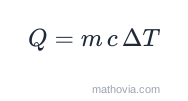
Specific Heat Calculator formula
The Specific Heat formula

The specific heat formula

is the heat energy in joules, is the mass in kilograms, is the specific heat capacity in J/(kg·°C), and is the temperature change in degrees Celsius. A positive is heating (energy in); a negative is cooling (energy out).

Worked example

The calculator’s defaults are 2 kg of water, a specific heat of 4184 J/(kg·°C), and a temperature change of 25°C.

Energy for a single degree first:

Then across the full 25 degrees:

That’s about 209 kJ, or 0.058 kWh — a useful reality check on why an electric kettle takes a couple of minutes and a fair chunk of a power bill’s worth of energy to boil a litre or two.
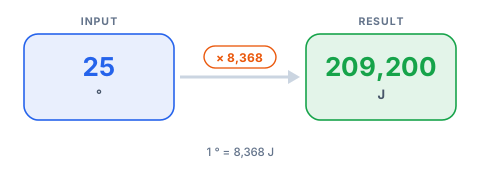
Specific Heat Calculator worked example diagram
A visual read of the worked example above — the same numbers the calculator returns for its default inputs.

Specific heat of common substances

Substancec, J/(kg·°C)Energy to warm 1 kg by 25°C
Water4,184104,600 J
Ethanol2,44061,000 J
Air1,00525,125 J
Aluminium90022,500 J
Glass84021,000 J
Steel49012,250 J
Copper3859,625 J
Lead1303,250 J

Water’s value stands out — nothing common comes close — which is why it’s the go-to coolant and thermal buffer.

Where the calculation is used

  • Sizing heaters and coolers. How many watts to raise a tank of water by a set amount in a set time.
  • Calorimetry. Measuring a reaction’s heat by the temperature change it causes in a known mass of water.
  • HVAC and building physics. The thermal mass of concrete and masonry slows a building’s temperature swings.
  • Cooking and food processing. Heating and chill-down times for large batches.
  • Climate and oceanography. The ocean’s enormous heat capacity is why coastal climates are mild.

What the formula assumes

It assumes all the energy goes into the substance and none leaks to the container, the air, or the surroundings — which is never quite true. Real heating jobs need more energy than the bare figure. It also assumes no phase change: melting or boiling needs the latent heat added on top, because temperature holds steady while a substance changes state.

Common mistakes

  • Mixing units — mass in grams with a c in J/(kg·°C) gives an answer 1,000× too small.
  • Ignoring the container in a real heating calculation.
  • Forgetting latent heat when the process crosses a melting or boiling point.
  • Using a Celsius specific heat with a Kelvin temperature change — the size of a degree is the same, so ΔT is identical, but be consistent.

For thermodynamic work that also involves pressure–volume changes, see the enthalpy calculator.

About the formula: Heat energy equals mass multiplied by specific heat capacity and temperature change. A positive temperature change represents heat absorbed, while a negative change represents heat released.

Frequently Asked Questions

What is specific heat capacity?+

The energy needed to raise one kilogram of a substance by one degree Celsius. Water's is high, 4184 J/(kg·°C); metals are much lower, around 130 to 900.

How much energy does it take to heat 2 kg of water by 25°C?+

Q = 2 × 4184 × 25 = 209,200 J, about 209 kJ or 0.058 kWh. That's why heating bathwater takes real energy and time.

What units does the calculator use?+

Mass in kilograms, specific heat in joules per kilogram per degree Celsius, temperature change in degrees Celsius. The result is in joules. Divide by 1,000 for kJ, or by 3,600,000 for kWh.

Can the temperature change be negative?+

Yes. A negative ΔT means the substance is cooling, and the result comes out negative — energy leaving the substance rather than entering it.

Why does water take so much energy to heat?+

Its specific heat is among the highest of any common substance. Hydrogen bonds between water molecules absorb energy as motion without the temperature rising much. This is why oceans moderate climate and why water is used as a coolant.

Does this account for a phase change?+

No. The formula only covers warming or cooling within one phase. Melting ice or boiling water needs the latent heat of fusion or vaporization added separately.

Related calculators