
The Reynolds number answers one question about a moving fluid: will it flow in smooth, orderly layers, or will it break up into chaotic swirls? It does this by comparing two competing forces — inertia, which keeps the fluid barrelling along and amplifies any disturbance, and viscosity, which damps disturbances out. When inertia wins by a wide margin the flow is turbulent; when viscosity holds its own the flow is laminar. Because it’s a ratio of forces, the Reynolds number has no units, and the same value predicts the same flow behaviour whether the fluid is air over a wing or water in a pipe.
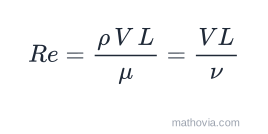
The Reynolds number formula
The characteristic length depends on the geometry: the inside diameter for a pipe, the chord length for an airfoil, the diameter for flow past a sphere or cylinder.
How to Calculate Reynolds Number (step by step)
Step One: Identify the fluid properties
Start with the fluid density and dynamic viscosity. Density describes how much mass occupies a given volume, while dynamic viscosity describes the fluid’s resistance to shearing motion.
Density = 998 kg/m³
Dynamic viscosity = 0.001 Pa·s
Step Two: Identify velocity and length
Use the relevant flow velocity and characteristic length. For pipe flow, characteristic length is usually the inside diameter. For flow over an object, it may be the object’s length, width, or another geometry-specific dimension.
Velocity = 2 m/s
Characteristic length = 0.05 m
Step Three: Multiply density, velocity, and length
Multiply the three quantities that represent the fluid’s inertial effects.
Density × velocity × characteristic length
= 998 × 2 × 0.05
= 99.8
Step Four: Divide by dynamic viscosity
Divide the intermediate value by dynamic viscosity to obtain the Reynolds number.
Re = (density × velocity × characteristic length) ÷ dynamic viscosity
Re = 99.8 ÷ 0.001
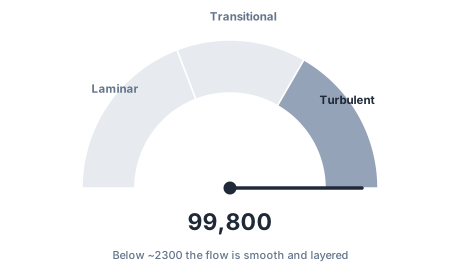
Re = 99,800
What your results mean
A Reynolds number of 99,800 is classified as turbulent for the common internal-flow thresholds used by this calculator. Laminar flow is generally associated with values up to 2,300, transitional flow with values from 2,300 to 4,000, and turbulent flow with values above 4,000.
These boundaries are guidelines rather than universal laws. Internal pipe flow, flow over a flat surface, flow around a cylinder, and flow through a porous medium can use different characteristic lengths and transition behavior. The result does not directly calculate pressure loss, drag, or energy consumption. Instead, it helps you choose appropriate models for those later calculations.
For an alternate form, Reynolds number can also be written as velocity times characteristic length divided by kinematic viscosity. The two forms are equivalent when dynamic viscosity equals density multiplied by kinematic viscosity.
Frequently asked questions
Is Reynolds number a unit?
No. Reynolds number is dimensionless because the units cancel during the calculation. It is normally written as Re rather than with a physical unit.
Why does viscosity reduce Reynolds number?
Viscosity resists fluid deformation and motion differences between neighboring layers. Increasing dynamic viscosity therefore increases the denominator and lowers Reynolds number, making smooth, orderly flow more likely.
Is turbulent flow always undesirable?
No. Turbulence can increase mixing and heat transfer, which may be useful in some systems. It can also increase energy losses and complicate flow predictions, so whether it is desirable depends on the application.
Flow regimes and typical thresholds
| System | Laminar | Transitional | Turbulent |
|---|---|---|---|
| Flow in a round pipe | Re < 2,300 | 2,300 – 4,000 | Re > 4,000 |
| Flow over a flat plate | Re < 5 × 10⁵ | around 5 × 10⁵ | Re > 5 × 10⁵ |
| Flow around a sphere | Re < ~1 | — | Re > ~1,000 |
| Open-channel flow | Re < 500 | 500 – 2,000 | Re > 2,000 |
The 99,800 from the worked example is turbulent for pipe flow by a wide margin — as most practical water and gas piping is.
Where the Reynolds number is used
- Pipe and duct design — it selects the friction-factor correlation (laminar Hagen–Poiseuille versus turbulent Colebrook) used to size pumps and fans.
- Aerodynamics and hydrodynamics — drag coefficients on wings, hulls, and vehicles are tabulated against Reynolds number.
- Heat exchangers and reactors — turbulence is often deliberately induced to raise heat and mass transfer.
- Scale modelling — a wind-tunnel or towing-tank model must match the full-scale Reynolds number for the results to transfer.
- Microfluidics — channel flows sit at Re well below 1, so everything is laminar and mixing must be engineered.
Common mistakes
- Mixing unit systems. All four inputs must be SI, or convert kinematic viscosity properly.
- Using the wrong characteristic length — radius instead of diameter for a pipe halves the result.
- Applying pipe thresholds to external flow, which transitions at a Reynolds number hundreds of times higher.
- Treating the transition value as exact — surface roughness and inlet disturbances shift it.
For related fluid work, the density calculator gives the ρ term this formula needs.