
Almost every electrical calculation on this site is Ohm’s law wearing a different hat. Volts to amps, watts to amps, wire sizing, voltage drop — they all come back to one relationship between four quantities, plus the power equation that ties them together. Learn the two and you can derive the other twelve on demand.

Ohm’s law
The physical reading is straightforward. Voltage is the pressure driving charge through a circuit, current is how much charge actually moves per second, and resistance is what opposes it. Raise the pressure and more flows; raise the resistance and less does.
The power equation
Ohm’s law alone cannot tell you how much energy a circuit is using. That takes a second relationship:
Substituting Ohm’s law into it gives two more forms that avoid needing a quantity you may not have:
All twelve formulas
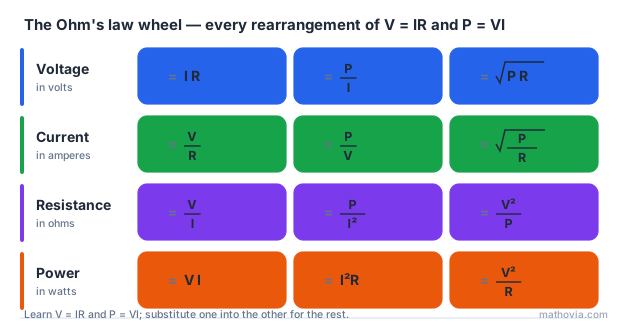
| Solving for | Form 1 | Form 2 | Form 3 |
|---|---|---|---|
| Voltage | |||
| Current | |||
| Resistance | |||
| Power |
You never need to memorise all twelve. Memorise
Worked example
A 6-ohm resistor carrying 2 amps.
Step 1 — voltage across it, straight from Ohm’s law.
Step 2 — power dissipated, using the form that needs only what we started with.
Step 3 — cross-check with a different form.
Two routes, same answer. That agreement is the standard sanity check — if two forms of the power equation disagree, one of the inputs is wrong.
Twenty-four watts is worth pausing on. A resistor dissipating that much needs to be physically large or heatsinked; a quarter-watt component in that position would fail within seconds. The power figure is usually the one that decides whether a design is practical.
A worked example that runs the other way
A 1,200-watt space heater on a 120-volt outlet. What does it draw, and what does it look like electrically?
Step 1 — current.
Step 2 — effective resistance.
Ten amps on a 15-amp circuit is 67 percent of its rating, which is why running two of these on one circuit trips the breaker. Move the same heater to 240 volts and it draws 5 amps instead — same power, half the current, a quarter of the heating loss in the supply cable.
Reference values
| Situation | Voltage | Typical current |
|---|---|---|
| AA battery, small load | 1.5 V | 0.01–0.5 A |
| Car electrical system | 12 V | 5–100 A |
| USB-C phone charging | 5–20 V | 1.5–3 A |
| US household outlet | 120 V | up to 15 A |
| US dryer / range circuit | 240 V | 30–50 A |
| Standard LED indicator | 2 V drop | 0.02 A |
An LED is a useful case to run the numbers on. Feeding a 2-volt LED from a 5-volt supply means dropping 3 volts across a series resistor at 20 milliamps:
That is the single most common practical application of Ohm’s law there is.
Where Ohm’s law stops working
Non-ohmic components. Diodes, LEDs, transistors and filament bulbs do not have a constant resistance. A tungsten filament’s resistance rises roughly tenfold between cold and operating temperature, which is why bulbs draw a large inrush current and usually fail at switch-on.
AC with reactive loads. With motors, transformers and capacitors, current lags or leads voltage and you need impedance rather than plain resistance. Real power then becomes
Temperature. Even ordinary resistors drift with temperature. For copper, resistance rises by about 0.4 percent per degree Celsius, which matters over a long cable run on a hot day.
Common mistakes
- Mixing milliamps with amps. 20 mA is 0.02 A. Leaving it as 20 makes every downstream figure a thousand times too big.
- Using
on a reactive AC load. That gives apparent power in VA, not real power in watts. Multiply by the power factor. - Forgetting to square the current in
. It is the squaring that makes heating grow so fast with current. - Using supply voltage instead of the voltage across the component. For a series resistor it is the drop across that resistor that matters, not the whole supply.
- Treating a battery as an ideal source. Real cells have internal resistance, so terminal voltage sags under load — noticeably so on a nearly flat battery.
For the everyday one-step conversions this page generalises, the site has dedicated tools: volts to amps, amps to watts and watts to volts. For splitting a supply voltage across two resistors, use the voltage divider calculator.