
Why solve watts to volts
Most of the time you know the supply voltage and you’re solving for current or power. Occasionally it runs the other way: a spec sheet gives a wattage and a current but not the voltage, or you’ve measured current with a clamp meter and know the device’s rated power, and you want to back out what voltage it must be running on. That’s what this does — it rearranges the power formula to isolate voltage.
It’s a useful sanity check rather than a substitute for a meter. If the numbers you feed in are consistent, the result lands on a familiar figure like 120 V or 240 V. If it lands somewhere strange, that’s telling you one of the inputs is wrong.
The watts to volts formula
Real power in a single-phase AC circuit is voltage times current times power factor:
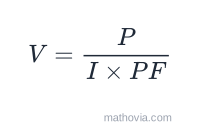
Solving that for voltage:
Worked example
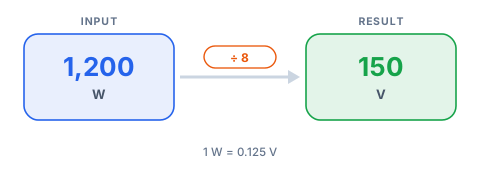
The calculator’s defaults are 1,200 W, a current of 10 A, and a power factor of 0.8.
First combine current and power factor:
Then divide the wattage by that:
The arithmetic gives 150 V. That’s not a standard supply voltage, which is the useful signal here: a real 1,200 W load either doesn’t draw exactly 10 A, or its power factor isn’t exactly 0.8. On a true 120 V circuit, a 1,200 W resistive load would draw 10 A at a power factor of 1; a 1,200 W load at power factor 0.8 on 120 V would draw 12.5 A. The calculator faithfully reports what the inputs imply — it’s up to you to notice when they don’t describe a real circuit.
A consistent example
Take a 1,200 W resistive heater known to draw 10 A, with a power factor of 1:
That’s a clean 120 V, which matches a standard North American branch circuit — the inputs are self-consistent.
Watts and amps to voltage
Assuming a resistive load (power factor 1):
| Power | 5 A | 10 A | 15 A | 20 A |
|---|---|---|---|---|
| 600 W | 120 V | 60 V | 40 V | 30 V |
| 1,200 W | 240 V | 120 V | 80 V | 60 V |
| 1,800 W | 360 V | 180 V | 120 V | 90 V |
| 2,400 W | 480 V | 240 V | 160 V | 120 V |
The diagonal of familiar values — 1,200 W at 10 A, 1,800 W at 15 A, 2,400 W at 20 A all landing on 120 V — is a quick way to spot whether a wattage and current pair is physically sensible for a household circuit.
What the result means
The voltage returned is the supply voltage implied by the power and current you entered. It assumes the power factor is accurate and the circuit is single-phase. Because power factor is rarely printed and often has to be estimated, treat the output as an approximation. For anything you’re about to touch with a tool, measure the voltage directly.
Common mistakes
- Leaving power factor at 0.8 for a resistive load. A heater or incandescent bulb is power factor 1; using 0.8 inflates the voltage result by 25%.
- Expecting a standard voltage from mismatched inputs. If the amps and watts don’t correspond to a real 120 V or 240 V operating point, the answer won’t either.
- Applying it to three-phase. This form has no √3 term and will overstate a three-phase line-to-line voltage.
For the more common direction, use the volts to watts calculator. To find current from power and voltage, see watts to amps; for resistance-based circuits, amps to volts uses Ohm’s law.