
Why you’d convert watts to amps
Nameplates and spec sheets almost always give you power in watts. Circuits, breakers, wire, extension cords, inverters, and generators are all rated in amps. The gap between those two units is where this conversion lives.
Say a space heater is labeled 1,500 W. Plugged into a 120 V outlet it draws about 12.5 A, which nearly fills a 15 A branch circuit on its own. Move that same 1,500 W to a 240 V circuit and the draw halves to about 6.25 A. The wattage never changed; the current did, because current depends on voltage. For anything with a motor or a switching power supply, power factor pulls the current up further still. So watts alone can’t tell you whether a load is safe on a given circuit — you need the voltage, and for AC motor loads, the power factor too.
The watts to amps formula
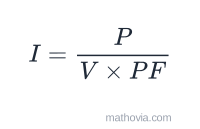
For a single-phase AC circuit, which covers essentially every household outlet in North America:
For a three-phase circuit, common in workshops and commercial buildings, the line current also divides by the square root of three:
In both,
Worked example: single-phase
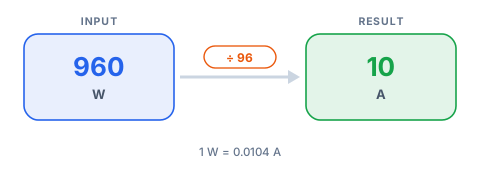
The calculator’s defaults describe a 960 W load on a 120 V circuit at a power factor of 0.8. Work it in two moves.
First, combine the voltage and power factor:
Then divide the wattage by that:
The load draws 10 amps. On a 15 A circuit that leaves 5 A of slack, but because a load running longer than three hours counts as continuous under the National Electrical Code, that circuit is really only good for 12 A of continuous draw. Ten amps fits with a little room to spare — not a lot.
Worked example: three-phase
Take a 7,500 W three-phase motor fed at 400 V with a power factor of 0.85:
Wire that same motor to a single-phase 240 V supply and it would need about 36.8 A. That five-to-one drop per conductor is the reason bigger equipment runs on three phase: thinner wire, smaller contactors, cheaper installation.
Watts to amps at common voltages
The chart below assumes a resistive load (power factor 1). For a motor, compressor, or cheap electronic supply, divide the amps figure again by the power factor — usually 0.7 to 0.9 — to get the real draw.
| Power | 12 V DC | 120 V | 240 V |
|---|---|---|---|
| 100 W | 8.3 A | 0.83 A | 0.42 A |
| 500 W | 41.7 A | 4.2 A | 2.1 A |
| 1000 W | 83.3 A | 8.3 A | 4.2 A |
| 1500 W | 125 A | 12.5 A | 6.25 A |
| 3000 W | 250 A | 25 A | 12.5 A |
| 5000 W | 417 A | 41.7 A | 20.8 A |
The 12 V column is why battery and inverter cabling is so heavy: pushing a kilowatt through a 12 V system means moving more than 80 amps, and current is what dictates conductor size.
Sizing the breaker above the running current
The amps this calculator returns is the steady operating current. It is not the breaker size. Three things usually sit on top of it:
- Continuous-load rule. For anything on for three hours or more, size the circuit to 125% of the load — or, the same thing from the other direction, never load a breaker past 80% of its rating. A 10 A continuous load wants a 15 A or 20 A circuit, not a 10 A one.
- Inrush. Motors, compressors, and transformers pull three to eight times their running current for a fraction of a second at startup. A properly rated breaker rides through it; an undersized one nuisance-trips every time the compressor kicks on.
- Derating. Conductors bundled in conduit or run through a hot attic carry less than their free-air rating, so the wire may need to go up a gauge even when the breaker doesn’t.
Power factor without the jargon
Power factor is the share of the current that does real work. A resistive load — a heating element, an incandescent filament — turns every amp into heat or light, so its power factor is 1. A motor, a fluorescent ballast, or a bargain-bin switching supply draws extra current that flows in and back out of a magnetic field without doing anything useful, which drags the power factor down to somewhere around 0.6 to 0.9. Lower power factor, more current for the same watts. That is exactly why factories install correction capacitors and why utilities bill industrial customers a penalty for poor power factor.
Rough values worth remembering: resistance heater and incandescent bulb, 1.0; induction motor, 0.8 to 0.9 near full load and much worse when lightly loaded; LED driver, anywhere from 0.5 to 0.9; a desktop PC supply, 0.6 to 0.7 unless it is power-factor-corrected, in which case 0.95 or better.
Where this comes up
- Inverter and battery sizing. An off-grid or RV system needs the current on the battery side: load watts divided by battery voltage, plus 10 to 15% for inverter inefficiency. That figure sizes the battery cable and the DC fuse.
- Generator sizing. A generator’s running-watt rating has to clear the sum of your loads, and its surge rating has to swallow the startup spike of the largest motor — often the well pump or the air conditioner.
- Extension cords. A 12 A load on a 100 ft cord needs 12 AWG copper. Run it on a 16 AWG cord and the voltage sags, the cord warms up, and a motor at the far end runs hot.
- Balancing a panel. Adding the amps on each leg of a split-phase panel shows whether one side is carrying far more than the other.
Common mistakes
- Multiplying a clamp-meter current reading straight by voltage and calling the answer watts. That product is volt-amps — apparent power — and it is larger than the real power by whatever the power factor is.
- Entering 120 V for a 240 V appliance. Dryers, ranges, water heaters, and most air conditioners are 240 V, and using the wrong figure doubles or halves the result.
- Leaving power factor at 1 for a motor. It makes the load look lighter than it is and understates the current.
- Sizing the breaker to match the running amps instead of leaving the 25% headroom the code expects.
For the reverse conversion, use the amps to watts calculator. If you know the resistance rather than the power, volts to amps applies Ohm’s law directly, and for energy over time see kWh to watts.