
What volts to amps solves
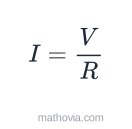
Given a voltage and a resistance, how much current flows? That’s Ohm’s law read for current, and it’s the calculation behind checking whether a resistive load — a heating element, a resistor network, a length of nichrome wire — will draw more current than its circuit is rated for, before you plug it in.
The catch is right there in the word “resistive.” The formula is exact for anything whose resistance stays put as the voltage changes. It is not a way to predict the current a motor, an LED, a phone charger, or a TV will pull, because those loads don’t obey a fixed volts-to-amps ratio.
The volts to amps formula
Worked example
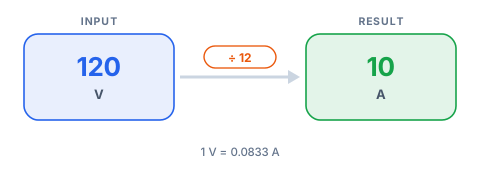
The calculator’s defaults are 120 V across a 12 Ω load.
Ten amps. That’s a coherent snapshot of a standard circuit: a 12-ohm resistive element is about a 1,200 W heater, and 10 A is exactly what it draws from a 120 V outlet. On a 15 A branch circuit that leaves only 5 A of margin, and under the National Electrical Code’s continuous-load rule a circuit running three hours or more should be loaded to no more than 80% — 12 A on a 15 A circuit — so this load is close to that ceiling.
Voltage and resistance to current
| Voltage | 5 Ω | 12 Ω | 24 Ω | 60 Ω | 240 Ω |
|---|---|---|---|---|---|
| 12 V | 2.4 A | 1.0 A | 0.5 A | 0.2 A | 0.05 A |
| 120 V | 24 A | 10 A | 5 A | 2 A | 0.5 A |
| 240 V | 48 A | 20 A | 10 A | 4 A | 1 A |
Halving the resistance doubles the current. That’s the relationship that makes a partial short circuit dangerous: as resistance collapses toward zero, current climbs toward whatever the supply and wiring will allow.
What the result assumes
The current returned assumes the resistance is fixed and the load is purely resistive. Real conductors and elements gain a few percent of resistance as they heat, so a value from a cold measurement predicts slightly more current than the circuit will draw once warm. For anything safety-critical, confirm the actual draw with a clamp meter rather than relying on a calculated figure.
Common mistakes
- Applying it to non-resistive loads. A motor’s or power supply’s current comes from its nameplate, not from V ÷ R.
- Using a cold resistance for a hot circuit. Heating elements can be several percent higher in resistance at operating temperature.
- Confusing this with a power-based calculation. If you know watts rather than ohms, use amps = watts ÷ (volts × power factor) instead.
For the reverse, use the amps to volts calculator. To find current from power instead of resistance, see watts to amps, and for the power dissipated in the load, volts to watts.