
Why convert amps to watts
A clamp meter reads current. Breakers, appliance labels, generators, and electricity bills all talk in watts. To connect a measured amp reading to any of those, you multiply by the voltage — and for AC motor or electronic loads, by the power factor as well.
The distinction that trips people up is real power versus apparent power. Voltage times current gives apparent power in volt-amps (VA), which is what the wiring physically carries. Only the portion of that current in step with the voltage does work; the power factor is the fraction that counts. Watts is apparent power times power factor, and watts is what actually heats, spins, and gets billed.
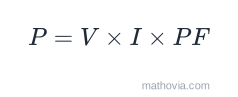
The amps to watts formula
Single-phase AC:
Three-phase, using line-to-line voltage:
Worked example
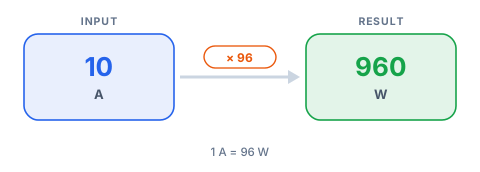
The calculator’s defaults describe a single-phase load: 10 A at 120 V with a power factor of 0.8.
Apparent power first:
Then scale by the power factor:
The load consumes 960 watts. The other 240 VA is reactive — carried by the wire, tracked by no meter. If the load were resistive, the power factor would be 1 and all 1,200 VA would be 1,200 W of real power.
Three-phase worked example
A three-phase load pulling 15 A per line at 208 V line-to-line, power factor 0.85:
Amps to watts reference
Resistive load, power factor 1:
| Current | 12 V | 120 V | 240 V |
|---|---|---|---|
| 1 A | 12 W | 120 W | 240 W |
| 5 A | 60 W | 600 W | 1,200 W |
| 10 A | 120 W | 1,200 W | 2,400 W |
| 15 A | 180 W | 1,800 W | 3,600 W |
| 20 A | 240 W | 2,400 W | 4,800 W |
For a motor or non-corrected electronic load, multiply the table figure by the power factor. A 15 A motor on 240 V at power factor 0.85 delivers about 3,060 W, not 3,600 W.
What the result tells you
The watts figure is the real power at the moment the current was measured — not necessarily the load’s rated wattage, since motors, heaters mid-cycle, and dimmed lights all draw less than their nameplate. For wire and breaker sizing, the apparent power (volts × amps, before the power-factor step) is the figure that matters, because that’s the current the conductors actually carry.
Common mistakes
- Calling volts × amps “watts.” That’s VA. Real power is lower by the power factor for any reactive load.
- Assuming power factor 1 for a motor. It overstates the wattage and hides how much current the circuit is really carrying.
- Using the wrong voltage. A 240 V appliance metered as 120 V halves the calculated power.
- Forgetting √3 for three-phase, or using phase voltage where line-to-line voltage belongs.
For the reverse, use the watts to amps calculator. If you know resistance instead of voltage, volts to amps applies Ohm’s law, and for kilowatt totals see amps to kilowatts.