
The mole: chemistry’s counting unit
The mole is to chemists what the dozen is to a baker — a fixed count you can refer to instead of listing individual items. The count just happens to be enormous: 6.02214076 × 10²³, a number with a name of its own, Avogadro’s number. It’s that large because atoms are that small. You need roughly six hundred sextillion of them before you have enough of a substance to see, weigh, and pour.
Almost every quantitative problem in chemistry passes through moles at some point. A balanced equation gives you the ratio in which substances react — two moles of hydrogen to one of oxygen — but a balance in the lab reads out grams. The mole is the exchange rate between the two, and the molar mass is the number you multiply or divide by to make the trade.
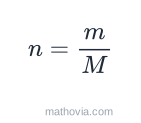
The mole formula
Worked example
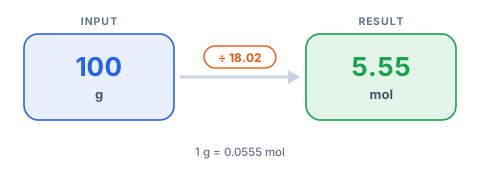
The calculator’s defaults describe 100 g of water, molar mass 18.015 g/mol.
Convert that to a molecule count:
Running it backward, 5.551 mol of water weighs
Grams, moles, and molecules for common substances
| Substance | Molar mass (g/mol) | 1 mole weighs | 100 g is |
|---|---|---|---|
| Water (H₂O) | 18.015 | 18.02 g | 5.551 mol |
| Sodium chloride (NaCl) | 58.44 | 58.44 g | 1.711 mol |
| Carbon dioxide (CO₂) | 44.009 | 44.01 g | 2.272 mol |
| Glucose (C₆H₁₂O₆) | 180.16 | 180.16 g | 0.555 mol |
| Ethanol (C₂H₅OH) | 46.07 | 46.07 g | 2.171 mol |
| Calcium carbonate (CaCO₃) | 100.09 | 100.09 g | 0.999 mol |
Where the mole conversion is used
- Stoichiometry. Convert a measured mass of reactant to moles, apply the equation’s mole ratio, convert the product back to grams.
- Solution preparation. Molarity is moles per litre, so making a 0.5 M solution starts with a mole-to-gram conversion.
- Gas problems. Moles link to volume through the molar volume (22.4 L/mol at STP) and to pressure through PV = nRT.
- Percent yield. Compare moles of product actually obtained against the moles theory predicts.
Common mistakes
- Using an element’s atomic mass for a diatomic gas. Oxygen gas is O₂, 31.998 g/mol, not 15.999.
- Forgetting hydrates. CuSO₄·5H₂O has a molar mass of about 249.7 g/mol, not 159.6.
- Rounding molar mass too early, which compounds through a multi-step calculation.
To look up or compute a molar mass, use the molar mass calculator. For a compound picker that fills in the molar mass automatically, see grams to moles, and for solution concentration, the molarity calculator.
A full stoichiometry chain
Moles are the middle step of nearly every reaction calculation. How much water forms from 10.0 g of hydrogen burning in plenty of oxygen? The equation is
The ratio of H₂ to H₂O is 2 : 2, so 4.96 mol of water forms:
Mass to moles, apply the mole ratio, moles back to mass: that pattern solves most stoichiometry problems.
Moles of a gas from its volume
At 0 °C and 1 atm, one mole of any ideal gas takes up about 22.4 L. So 44.8 L of nitrogen under those conditions is 2.00 mol, which weighs
Quick sense checks
- A spoonful of a substance is usually a fraction of a mole to a few moles, not thousands.
- If moles come out larger than the mass in grams, the molar mass must be below 1, which only makes sense for hydrogen atoms. Check that you divided rather than multiplied.