
What mole fraction measures
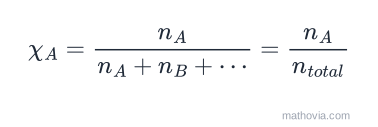
Mole fraction (χ) is the simplest possible way to describe a mixture: what share of the molecules present is each component? It’s a plain ratio — one component’s moles divided by the total moles — so it carries no units, doesn’t care about temperature or volume, and the fractions of all components always add to exactly 1.
That mathematical tidiness is why mole fraction, not molarity or mass percent, is the concentration variable in the equations of physical chemistry. Raoult’s law predicts a solution’s vapour pressure from mole fraction. Dalton’s law splits a gas mixture’s total pressure among components by mole fraction. Both would be far messier written in any volume- or mass-based unit.
The mole fraction formula
Worked example
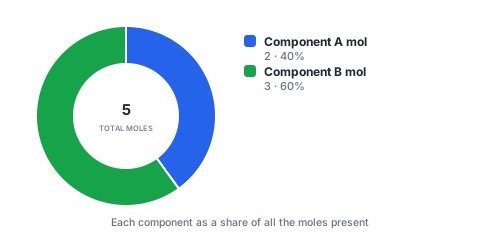
The calculator’s defaults are 2 mol of component A and 3 mol of component B.
Total moles:
Mole fractions:
Check: 0.400 + 0.600 = 1.000.
From mass to mole fraction
If you start with masses rather than moles, convert first. Say 40 g of methanol (32.04 g/mol) and 60 g of water (18.02 g/mol):
Even though water is only 60% by mass, it’s 73% by moles, because its molecules are lighter.
Composition of dry air, by mole fraction
| Component | Mole fraction | Partial pressure at 1 atm |
|---|---|---|
| Nitrogen | 0.7808 | 0.781 atm |
| Oxygen | 0.2095 | 0.209 atm |
| Argon | 0.0093 | 0.0093 atm |
| Carbon dioxide | 0.0004 | 0.0004 atm |
Each partial pressure is just the mole fraction times the total — Dalton’s law in one line.
Where mole fraction is used
- Raoult’s law — a component’s vapour pressure above a solution is its mole fraction times its pure vapour pressure.
- Dalton’s law — partial pressure equals mole fraction times total pressure.
- Phase diagrams and distillation — vapour–liquid equilibrium is plotted against mole fraction.
- Colligative properties — freezing-point and boiling-point shifts derive from the solvent’s mole fraction.
Common mistakes
- Using mass ratios directly instead of converting to moles first.
- Forgetting a component so the fractions don’t sum to 1.
- Confusing mole fraction with mole percent (mole fraction × 100).
To get the moles you need here from a mass, use the mole calculator. For the mass-per-solvent unit, see the molality calculator.
Raoult’s law with real numbers
Mole fraction predicts how much of each liquid is in the vapour above an ideal mixture. Each component’s partial pressure is its mole fraction times its pure vapour pressure. Using the methanol–water mixture above, with pure vapour pressures at 25 °C of about 16.9 kPa (methanol) and 3.17 kPa (water):
Methanol is only 27% of the liquid’s molecules but supplies about two-thirds of the vapour pressure, which is why distillation can separate the two. Real methanol–water mixtures deviate a little from ideal behaviour, so treat this as an estimate.
Three or more components
The formula doesn’t change. With 2 mol of A, 3 mol of B and 5 mol of C, the total is 10 mol, so
Mole fraction to molality
For a dilute solute in water, assume 1 mol of mixture in total. If