
What molarity tells you
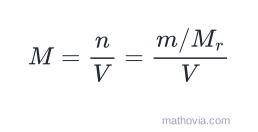
Molarity is the default way chemists state how strong a solution is: moles of dissolved substance per litre of the finished solution. “2 M HCl” means two moles of hydrochloric acid in every litre. Because reactions run on mole ratios, molarity is what lets you scoop out a measured volume of a solution and know exactly how many moles you’re adding — the basis of titrations, reagent dosing, and any calculation done in solution.
The definition hinges on one detail people get wrong: the volume is the total solution, measured after the solute is dissolved and the flask is topped up to the mark. It is not the volume of water you poured in first, which is smaller.
The molarity formula
Worked example
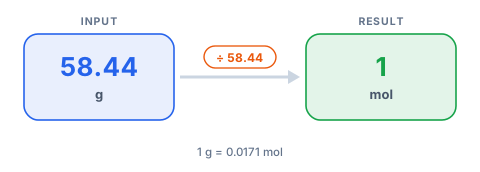
The calculator’s defaults are 58.44 g of NaCl (molar mass 58.44 g/mol) dissolved to a 1 L solution.
Moles of solute:
Molarity:
A 1 M sodium chloride solution — one “molar” NaCl.
How to prepare a solution of known molarity
| Target | Volume | Moles needed | Grams to weigh |
|---|---|---|---|
| 1 M NaCl | 1 L | 1.000 | 58.44 g |
| 0.5 M NaOH | 1 L | 0.500 | 20.00 g |
| 0.1 M HCl | 500 mL | 0.050 | (dilute stock) |
| 0.25 M glucose | 250 mL | 0.0625 | 11.26 g |
| 2 M H₂SO₄ | 1 L | 2.000 | (dilute concentrated acid) |
Weigh the solute into a volumetric flask, dissolve it in a portion of solvent, then add solvent up to the calibration line — never just add the solute to a full litre.
Where molarity is used
- Titration. The unknown’s concentration comes from the known titrant’s molarity and the volumes at the endpoint.
- Reaction stoichiometry in solution — moles from molarity × volume, then the equation’s ratio.
- Serial dilutions for standards and assays, each step governed by M₁V₁ = M₂V₂.
- Buffer and reagent preparation to a specified working concentration.
Common mistakes
- Using solvent volume instead of final solution volume.
- Adding solute to a full volume of solvent, which overshoots the mark once it dissolves.
- Forgetting a solute’s hydration or purity — a 90% pure reagent needs proportionally more mass.
- Mixing up molarity and molality in colligative-property problems.
To turn a molar mass and formula into the g/mol you need here, use the molar mass calculator. For the temperature-independent unit, see the molality calculator, and for serial-dilution ratios, the dilution ratio calculator.
Making a solution that isn’t one litre
Find the moles you need from molarity times volume (in litres), then convert to grams. For 250 mL of 0.20 M NaOH (molar mass 40.00 g/mol):
Dissolve 2.00 g of NaOH in some water in a 250 mL volumetric flask, then make it up to the mark.
Diluting a concentrated stock
Use
So the 50 mL of acid goes into enough water to make 600 mL in total. Add the acid to the water, not the water to the acid. Diluting concentrated acid releases heat, and adding water to acid can make it spatter.
Ion concentrations
Salts that split into several ions give a higher concentration of some ions than of the salt itself. 0.10 M CaCl₂ contains 0.10 M Ca²⁺ but 0.20 M Cl⁻, because each formula unit releases two chloride ions. Use the ion concentration when a problem asks about one particular ion, such as for precipitation or conductivity.