
Centimetres to inches is the conversion you reach for whenever a measurement comes in metric but your tools, materials, or habits are imperial — an overseas product spec, a doctor’s measurement, a pattern or plan from another country, a piece of metric hardware. It’s a single division by the exact factor 2.54, with the small extra step of turning the decimal remainder into a fraction you can actually find on a ruler.
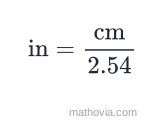
The cm to inches formula
To break the result into a tape-measure fraction, multiply the decimal part by 16 (for sixteenths) and round:
Worked example
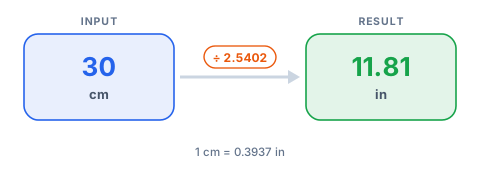
The calculator’s default is 30 cm.
That’s just under a foot. The decimal part is 0.811, so:
meaning 30 cm is about 11 13/16 inches on a ruler. In feet, it’s
What Your Results Mean
The Inches result is your primary decimal conversion for calculations and digital tools. The Feet result helps contextualize larger measurements. The Nearest 16th shows the fractional part in sixteenths of an inch, which is how standard tape measures are marked, making it easy to find the measurement physically.
Everyday conversion references
- 1 cm to inches = 0.39 inches
- 2.54 cm to inches = 1 inch (exact)
- 5 cm to inches = 1.97 inches
- 10 cm to inches = 3.94 inches
- 15 cm to inches = 5.91 inches
- 20 cm to inches = 7.87 inches
- 25 cm to inches = 9.84 inches
- 30 cm to inches = 11.81 inches
- 40 cm to inches = 15.75 inches
- 50 cm to inches = 19.69 inches
- 60 cm to inches = 23.62 inches
- 70 cm to inches = 27.56 inches
- 80 cm to inches = 31.50 inches
- 90 cm to inches = 35.43 inches
- 100 cm to inches = 39.37 inches
- 110 cm to inches = 43.31 inches
- 120 cm to inches = 47.24 inches
- 130 cm to inches = 51.18 inches
- 140 cm to inches = 55.12 inches
- 150 cm to inches = 59.06 inches
- 152 cm to inches = 59.84 inches (about 5 feet)
- 160 cm to inches = 62.99 inches (about 5 feet 3 inches)
- 165 cm to inches = 64.96 inches (about 5 feet 5 inches)
- 170 cm to inches = 66.93 inches (about 5 feet 7 inches)
- 175 cm to inches = 68.90 inches (about 5 feet 9 inches)
- 180 cm to inches = 70.87 inches (about 5 feet 11 inches)
- 183 cm to inches = 72.05 inches (about 6 feet)
- 185 cm to inches = 72.83 inches (about 6 feet 1 inch)
- 190 cm to inches = 74.80 inches (about 6 feet 3 inches)
- 195 cm to inches = 76.77 inches (about 6 feet 5 inches)
- 200 cm to inches = 78.74 inches (about 6 feet 7 inches)
- 210 cm to inches = 82.68 inches (about 6 feet 11 inches)
- 220 cm to inches = 86.61 inches (about 7 feet 3 inches)
Monitor and TV screen sizes
Screens are measured diagonally in inches but specs often include cm dimensions. A “27-inch” monitor is 68.58 cm diagonal. If you see a metric spec like “80 cm diagonal” and need the marketing size: 80 / 2.54 = 31.5 inches.
For the reverse conversion, the inches to cm calculator multiplies by 2.54. If you need millimeter precision, convert your cm to mm first (multiply by 10) or use the mm to inches converter directly. For tape-measure-friendly fractions from any decimal inch value, the inches to fraction calculator handles that.
Centimetres to feet and inches
Convert to inches, then split off whole feet. For a height of 183 cm:
A quick mental method
Multiply by 0.4, which is the same as dividing by 2.5. 30 cm gives about 12 inches; the exact answer is 11.81. The shortcut runs about 1.6% high, fine for a rough size but not for a cut list.
Common mistakes
- Multiplying by 2.54. That converts inches to cm. Going from cm to inches, divide by 2.54.
- Reading 1.70 m as 1 ft 70 in. Convert metres to cm first (170 cm), then to inches (66.9 in, or 5 ft 7 in).
- Rounding a screen size wrongly. A 140 cm diagonal is 55.1 inches, which is why it’s sold as a 55-inch screen.
- Treating the decimal as a fraction. 11.81 inches is not 11 and 81/100 on a tape. Convert 0.81 to about 13/16.